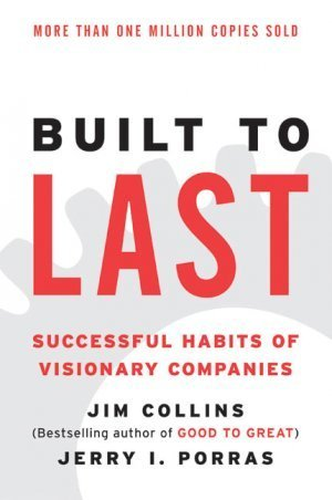
I read most of Built to Last standing up, in a kitchen, waiting for water to boil. Not romantic. Just the only quiet I could find that week. Jim Collins and Jerry Porras had been sitting on my shelf for two years, and I kept avoiding them because I assumed this was another book telling me to write a mission statement and post it in the break room.
It isn’t that.
The central argument, the one everything else orbits, is this: the companies that last are not led by irreplaceable people. They are designed so that no single person is irreplaceable. Collins and Porras call it clock building. The leader who tells time gives you the correct hour today. The leader who builds a clock gives you a way to tell time forever, including after they’re gone.
That question sat with me. If my own work vanished tomorrow, would the thing I built keep ticking, or would it just stop?
The Leader Who Made Himself Unnecessary
The book’s emotional center isn’t a person. It’s an absence. Collins and Porras studied eighteen companies with an average age near a century, and what they found, again and again, was founders who deliberately made themselves less necessary. David Packard and William Hewlett built HP around practices and culture rather than their own personalities. Walt Disney set up training, storyboards, and an animation school so the studio could outlive his hand on any single drawing.
The villain of the book is the charismatic genius. Not because charisma is bad. Because it’s a single point of failure dressed as a strength. The comparison companies in the study often had brilliant, magnetic leaders, and those companies stumbled when the leader left. The visionary companies had quieter architects, and they kept going.
Here’s the conflict that kept me tense through the middle chapters. If you build a clock, you have to accept that the clock will run without you. That means giving up the thing most ambitious people quietly want, which is to be needed. I sat with that one for a while. Still sitting with it.
Holding Two Contradictions at Once
The most useful idea in the book is what Collins and Porras call the Genius of the AND, set against the Tyranny of the OR. Most leaders assume they must choose: stability or change, profit or purpose, tight culture or individual freedom. The visionary companies refuse the choice. They hold both.
It sounds like a motivational poster until you see the case. Merck gave away a drug for river blindness in regions where it could never recoup the cost, and still ran a demanding, profitable business. Ford cut wages in some periods and raised them dramatically in others, betting on the long game. The point isn’t that these companies were saints. The point is that they engineered structures that let contradictory commitments coexist.
The recurring image is a clock, but the second image matters more: the core and the progress. The core stays frozen. Everything else is allowed to burn and be rebuilt. A company that changes its core loses itself. A company that changes nothing dies. That tension is the whole book.
What the book doesn’t soften is the cost. Collins and Porras are blunt that these companies are not pleasant places for everyone. Fit the ideology or leave. They describe it as almost cult-like. That’s not a marketing problem. That’s a real price, and the book doesn’t flinch from it.

What the Winners Leave Out
The research is genuinely impressive. Eighteen companies, matched against direct competitors, studied from founding to present. The pairing method is what makes the claims land. When you compare Motorola to Zenith, or Boeing to McDonnell Douglas, the pattern stops looking like luck.
What the book leaves out is survivorship. Collins and Porras picked winners and worked backward. Some of their visionary companies later struggled badly. Others were acquired. The framework explains the past beautifully and predicts the future less reliably than the tone suggests. I noticed this around chapter six and couldn’t unsee it.
Read this if you’re building something and want it to outlast your involvement. Read it if you’re a founder who secretly enjoys being the only one who can fix things, because it will make you uncomfortable in a useful way. Skip it if you want tactical playbooks. This is architecture, not carpentry. Skip it if you need the research methodology to be airtight, because it isn’t.
What I took away isn’t a formula. It’s a question I now ask about my own work: am I telling time, or am I building something that tells time without me? I don’t have a clean answer yet.
“Clock building is the ultimate act of leadership, because it requires you to build something that will outlast you.”

