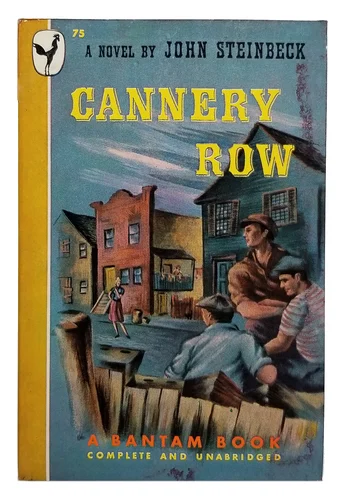
When you turn to Cannery Row, Steinbeck’s shabby street is home to a group of losers: homeless people, gamblers, prostitutes and thieves. They don’t have a serious job, live in an abandoned warehouse, and worry about the next meal every day. By worldly standards, they would normally be dismissed. But as I read it, I found that I was completely wrong.
This novel, published in 1945, is set in a dilapidated street in Monterrey, California. The people there are extremely materially poor, but they seem to be freer and more relaxed than most people I know. The street written by Steinbeck is chaotic, noisy and dirty, but strangely beautiful.The novel begins:
“Cannery Row in Monterey in California is a poem, a stink, a grating noise, a quality of light, a tone, a habit, a nostalgia, a dream.“
When I first read that sentence, I paused. How could a place be both a “stink” and a “poem”? But as I read on, I began to understand that perhaps every place that truly feels alive is exactly like that—imperfect, chaotic, and full of contradictions.
At the center of the story is Doc, a marine biologist. By society’s standards, he is the only truly “successful” person on the street: educated, respected, and professionally accomplished. Mack and the boys, who live in an abandoned building nearby, are his complete opposite. They have no stable jobs and survive through odd schemes and petty theft. Yet Steinbeck never writes them as pathetic figures.
One description of Mack stayed with me:
“Mack and the boys are the Beauties, the Virtues, the Graces.“
While reading, I could not help comparing them to certain well-dressed, ambitious people in real life who climb over others in the name of success. In the end, who is truly “respectable,” and who is actually hollow inside? The answer suddenly no longer felt obvious.
One scene in particular affected me deeply. Mack and the boys decide to throw a party for Doc. They prepared everything carefully, but finally messed up the party and made a mess of the doctor’s laboratory. The next morning, the doctor came back and saw the mess all over the place. He should be furious. But after listening to their explanation, he just said calmly:
“It has always seemed strange to me… The things we admire in men, kindness and generosity, openness, honesty, understanding and feeling are the concomitants of failure in our system. And those traits we detest, sharpness, greed, acquisitiveness, meanness, egotism and self-interest are the traits of success.“
I reread that passage several times. According to the world we live in, the best human qualities—kindness, generosity, honesty, empathy—often lead nowhere. Meanwhile, greed and selfishness are frequently rewarded. What struck me most was that Doc says this without anger. He sounds genuinely puzzled, almost as if he is speaking to himself. At that moment, I realized I shared his confusion.
For most of my life, I have always been chasing the “next step.” First, I studied hard to find a good job. Then I worked hard to move even further upward.I’ve always told myself that I can’t stop here. But at some point, as I look around, I find that many of the so – called successful people I know have never truly relaxed.
Doc describes this perfectly when he says about Mack and the boys:
“In a time when people tear themselves to pieces with ambition and nervousness and covetousness, they are relaxed.”
Those who seem to have everything are often physically tired and mentally empty. The homeless people on the street of the cannery row sit on the rusty pipes during the day to blow the sea breeze, and drink some cheap wine at night, but they can still laugh. They may be poor, but their souls are not crushed.
Steinbeck does not romanticize poverty, nor does he turn these characters into heroes. Instead, he simply writes:
“Look at them. There are your true philosophers.“
After finishing the book, I kept thinking about Mack and the boys. Of course, their lives are not meant to be a model for anyone. No one should seriously aspire to live exactly like them. But the strange kind of freedom they possess on that filthy little street made me question something I had rarely questioned before: Is the version of “success” we spend our entire lives chasing really worth sacrificing ourselves for? Complete failure is not something to glorify. But perhaps there is another possibility somewhere in between—a life that is imperfect, unpolished, and not constantly driven by anxiety and competition.
In Cannery Row, Steinbeck offers no grand answer. What he gives instead is something quieter and gentler. And somehow, after reading it, I felt able to put down a little of the weight I had been carrying.
