I was folding laundry the other day. My wife’s jeans have these tiny, fake pockets. You know the ones. You can’t fit a phone in them, let alone a hand. I got annoyed. Then I remembered this book.
Why do women’s clothes still lack pockets? That question led me to Claire McCardell. She designed in the 1930s and 40s. She did something radical: she put real pockets on women’s dresses. She gave women clothes they could move in. Run in. Live in. The book by Elizabeth Evitts Dickinson is not just a biography. It is a story about how America found its own fashion voice. It is also a story about one stubborn woman who refused to believe that practicality and beauty could not coexist.
Her Hands in the Fabric
Claire McCardell was not a rebel with a manifesto. She was a quiet force. She grew up in a world where women wore corsets and stiff fabrics. They were expected to look decorative. They were not expected to run. McCardell looked at this and thought, honestly, this is nonsense.
She designed the “popover” dress. A simple, comfortable dress you could wear at home. It had an oven mitt attached. A design for the real woman who cooked dinner. She made bathing suits with built-in bras. She made clothes that moved with the body, not against it. The core conflict of her life was simple: the fashion industry wanted women to look like statues. McCardell wanted women to look like themselves. She fought manufacturers who said her designs were too plain. She fought retailers who wanted fancier trims. She fought the French dominance of fashion. Her victory was not a single dress. It was a whole new way of thinking about clothes. I won’t tell you how her story ends. But I will say this: the ending is not a fairy tale. It is a quiet revolution that we are still living inside.
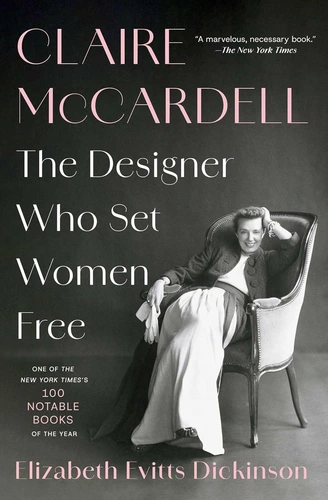
The Fabric of a Nation
The core theme of this book is freedom. Not the abstract kind. The kind you feel when you can bend over without your dress ripping. The kind you feel when you can carry your keys in your pocket. McCardell’s key imagery is the body in motion. She watched dancers. She watched women on the street. She saw how they twisted and stretched. Then she cut fabric to match that movement.
Dickinson, the author, writes with a light touch. She lets McCardell’s work speak for itself. But she also shows us the struggle. McCardell was designing during the Great Depression. Materials were scarce. She used cotton and denim. She used wool jersey. She made cheap materials look elegant. She proved that good design does not need expensive fabric. It needs good thinking. This character’s struggle reveals a universal pattern: the fight to be taken seriously as a woman in a man’s world. McCardell was not a loud feminist. She was a practical one. She changed the world by changing what women wore every single day.
What We Still Need to Learn
I finished the book and looked at my own closet. I have a pair of jeans. Deep pockets. I can fit a wallet, a phone, a set of keys. I never thanked the person who made that possible. The book does that work for us.
The cross-era resonance is striking. We still argue about pockets. We still argue about whether women’s clothes should be beautiful or practical. McCardell’s answer was clear: both. She was not interested in a trade-off. She was interested in integration. The core insight of this book is simple and profound: the clothes we wear are not just fabric. They are statements about who we are allowed to be. McCardell made room for women to be active, to be strong, to be themselves. She did it with a seam ripper and a sewing machine. She did it one dress at a time. Maybe that is what true design really is. Not a statement. Not a label. A quiet, stubborn insistence that you deserve to be comfortable in your own skin. And in your own pockets.
