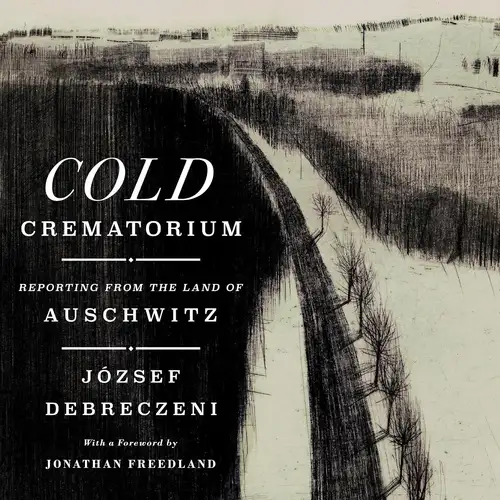
I have been thinking about my grandmother lately. She had a story she never told me. I knew it existed, a kind of shadow behind her eyes, but she chose silence. I used to think of it as a failure of courage. Then I read József Debreczeni’s Cold Crematorium, and I realized I was wrong.
This book was published in Hungarian in 1950. It vanished. No English translation existed for seventy years. Now it has been rediscovered, and reading it, I kept asking myself: what happens to a story that waits that long? Does it change? Does it rot? Or does it become something else entirely, something more honest?
The book asks a quiet, devastating question: what does it mean to survive when the world you knew has been erased?
The Man Who Walked Through the Crematorium
Debreczeni was a Hungarian Jewish journalist. He does not write like a hero. He writes like a man who has seen the inside of a machine and is trying, with terrible precision, to describe its gears.
The protagonist here is not a warrior. He is a prisoner who walks through the Auschwitz complex, from one camp to another, until he reaches a place called “Cold Crematorium.” That name. It is not a metaphor. It is a literal description of a building where bodies were stored before being burned. The coldness of that word, the deadpan way he reports it, is what makes this book so unsettling.
He does not scream. He does not rage. He describes the smell of burning flesh, the way the guards laughed, the way a man next to him died mid-sentence. All of it is recorded with the eye of a journalist who has seen too much to be shocked anymore.
I found myself holding my breath. The suspense is not about whether he will survive. We know he does. The suspense is about what survival costs. He gives us the price, line by line, without ever telling us the total.
But here is the thing that got me. He never asks for pity. He never frames himself as a victim. He is a witness. That is a different thing entirely. It is a colder, harder thing. And that is what makes the book so powerful. It does not want our tears. It wants our attention.
The Camp as a Factory of Erasure
Debreczeni’s core theme is not suffering. It is not even cruelty. It is erasure. The systematic, bureaucratic, almost mundane destruction of a person’s identity before their body is destroyed.
He describes the moment he lost his name. He became a number. He describes the way the camp administrators kept meticulous records of how many people entered and how many left. The numbers were clean. The people were not.
The key imagery here is the cold. Not just the Cold Crematorium, but the cold of the barracks, the cold of the guards’ eyes, the cold of the air that carried the smoke. Debreczeni uses coldness as a kind of emotional armor. He does not let himself feel. He records. And in that refusal to feel, he shows us something deeper: the slow freezing of the soul that happens when you live in a place designed to kill you.
I think this is why the book was buried for seventy years. It is not a comfortable story. It does not offer redemption. It does not show us the triumph of the human spirit. It shows us the endurance of a man who became a machine for seeing.
And yet. That is not the whole truth. Because he did write. He did record. He did not let the silence win completely. There is a kind of defiance in that. A small, cold flame.
The Long Wait for a Voice
I finished this book and I sat in my chair for a long time. I thought about my grandmother again. I thought about what it means to carry a story for decades, to let it grow quiet inside you, and then to set it free when the world might finally be ready to hear it.
Debreczeni’s book is not for everyone. It is hard. It is cold. It has no easy lessons. But that is exactly why it matters. It does not try to make us feel better about the past. It tries to make us see.
What did he gain by waiting seventy years? I think he gained perspective. He gained the ability to write not as a man still bleeding, but as a man who had already scarred over. The story is sharp and clear, not blurred by immediate grief.
I will be honest. I do not know if I could have read this book twenty years ago. I was not ready. Maybe the world was not ready either. That is the strange thing about silence. Sometimes it is not a failure. Sometimes it is a waiting room.
The core insight of Cold Crematorium is this: some stories need to age before they can be told. They need to become cold. And then, when they are finally spoken, they carry a weight that fresh grief cannot match. They carry the weight of a life that has been lived with the memory.
Maybe that is what my grandmother was doing. Not hiding. Waiting. For someone who could hear the cold.
