I was at a friend’s house last month. She had a framed print on her wall. It was a R. Crumb drawing from the 1960s. The lines were precise. The energy was chaotic. The subject was a woman with exaggerated features. I stared at it for too long. My friend said, “I know. I can’t decide if I love it or hate it either.”
That is the exact feeling Dan Nadel captures in his new biography, Crumb: A Cartoonist’s Life. It is not a simple story. It is not a celebration. It is a careful, sometimes painful examination. The book does not ask us to forgive Robert Crumb his flaws. It asks something harder. It asks: what does it mean to take a difficult artist seriously?
What the Biography Actually Does
The book is structured around Crumb’s life and his work. Nadel moves chronologically. He starts with Crumb’s childhood in Philadelphia. A quiet, odd boy. Obsessed with drawing. Surrounded by a family that was, honestly, a mess. His father was abusive. His mother struggled with mental illness.
Later, Crumb moves to San Francisco. The 1960s counterculture embraces him. His comic Zap Comix becomes a phenomenon. His characters like Mr. Natural and Fritz the Cat become icons. But here is where it gets complicated. Crumb’s work is full of graphic sexuality. His depictions of women are often degrading. His racial stereotypes are jarring. Some of it is hard to defend.
Nadel does not defend it. He does the harder thing. He shows us the work and says, “Look. This is what he made. This is who he was. Now what do you think?”
The biography is not an apology. It is a portrait. A full portrait with all the shadows.
The Central Question of the Book
I kept asking myself while reading: where is the line? When does an artist’s personal ugliness ruin their art? Or does it never? Crumb himself was shy, anxious, and often misanthropic. He drew his darkest impulses. He put them on paper. And people loved it. They still do.
Nadel’s argument is subtle. He suggests that Crumb’s honesty is both his gift and his problem. Crumb never censored himself. He drew what he thought. That produced work of raw power. But it also produced work that many people find offensive. The same impulse that made him great also made him hard to stomach.
I found myself nodding. I thought about other artists I admire. Some of them are not good people. But their work speaks to something true. Nadel does not give us an easy answer. He gives us the tension. He lets us sit in it.
The Craft of the Biography Itself
Nadel writes with a light touch. He is not showy. He lets the details speak. The book is dense with research. Interviews. Letters. Old sketchbooks. But it never feels like homework.
One thing I noticed. Nadel includes reproductions of Crumb’s actual drawings throughout the text. That is smart. You can see the evolution of his style. From the early nervous lines to the later, more confident cross-hatching. The art becomes a kind of proof. It grounds the biography in something real.
But there is a limit. The book is long. Over 500 pages. Sometimes I wanted Nadel to push harder. He is respectful of Crumb’s complexity. But I wanted a sharper thesis. I wanted him to say, “Here is what I think we should do with this artist.” Instead, he leaves the judgment to us. That is fair. But it also feels a little safe.
What You Will Get From Reading This
Honestly, this book is for people who are interested in the messy edges of creativity. If you want a clean hero story, look elsewhere. If you want a villain, you won’t find one either. What you get is a human being. Flawed. Brilliant. Confused. Sometimes cruel. Sometimes tender.
You will also get a deeper understanding of underground comics. Their history. Their politics. Their strange energy. Crumb was not alone. He was part of a movement. Nadel shows that context well.
And you will get a question that stays with you. Long after you close the book. About art. About morality. About what we are willing to live with.
The Last Word
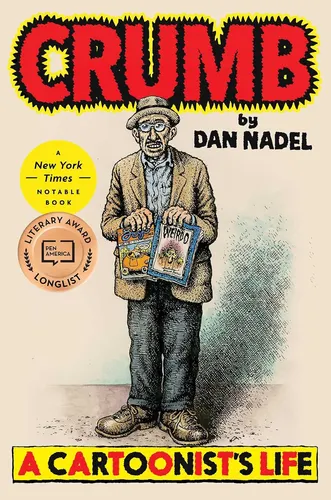
I finished the book on a Sunday afternoon. I sat on my couch. I looked at the cover. It is a self-portrait by Crumb. He looks tired. He looks aware of himself. I thought about my friend’s framed print. I still don’t know how I feel about it. But I know I am thinking about it. That is what good art does. It makes you think. It makes you uncomfortable. And maybe that is the point.
Crumb: A Cartoonist’s Life is not a comfortable read. But it is an important one. If you are willing to sit with your own discomfort, pick it up. You might not like what you find. But you will be richer for it.
