I read most of this book in a grocery store parking lot, which feels like the only honest place to admit it. Not because the setting matched the title. Because I kept having to stop, sit in the driver’s seat, and not drive anywhere for a while.
Michelle Zauner’s memoir asks a question I did not want to answer: if love arrives through food and criticism at the same time, how do you separate them after the person is gone?
I should say upfront that I did not expect to like this. Celebrity memoirs and I have a strained history. I opened it skeptical, arms crossed, ready to be unimpressed.
I was unimpressed for about nine pages.
What Happens, Briefly
Zauner grows up in Eugene, Oregon, the mixed-race kid in a white school, with a Korean mother who monitors her grades, her weight, her friends, her posture. The two of them fight for years. Her mother screams. Zauner screams back. There is hitting in this house, and it is described plainly, without either excuse or indictment.
Then, when Zauner is twenty-five, her mother is diagnosed with terminal pancreatic cancer. The daughter who spent a decade pulling away moves home to feed her.
That is the spine of it. The rest is memory, Seoul, hospital hallways, and an enormous amount of food.
The Character Who Cannot Say It
Zauner’s mother is one of the most vivid people I have met on a page this year. She is funny, exacting, proud, occasionally cruel, and she loves her daughter in a dialect her daughter spent years refusing to learn.
The core scene, the one I keep returning to, is a meal. Zauner cooks for her mother during chemo. Her mother has no appetite. Zauner gets angry about it. She knows, even while it’s happening, that the anger is misplaced, that she is furious at the cancer and taking it out on the person the food was for.
That scene broke something in me. I once cooked a whole dinner for someone who was sick and then ate it alone at the counter, furious at a plate.
The suspense here is not whether the mother dies. You know that from page one. The suspense is whether Zauner will get to say the thing she needs to say, and whether her mother will hear it, and I am not going to tell you how that goes.
What struck me most was how the book refuses to make the mother easy to love. It also refuses to make her a villain. It just leaves her a person.
Food as a Grammar Nobody Taught Her
The central argument of this book, as I read it, is that food is a language, and Zauner was functionally illiterate in her mother’s tongue until grief forced her to study.
This is where the writing earns its reputation. The descriptions of cooking are not decorative. They are arguments. When Zauner learns to make her mother’s dishes, she is not learning recipes. She is learning vocabulary she was too busy being American to bother with as a kid.
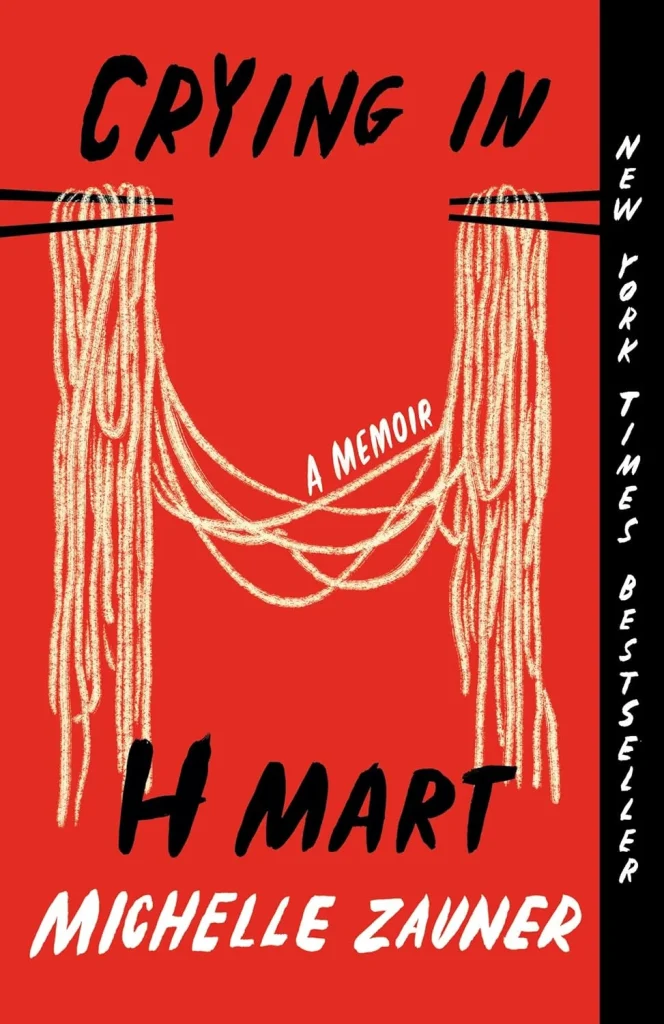
The H Mart of the title is a Korean grocery chain, and the crying happens there, in the aisles, over jars. It’s a strange and specific grief, being ambushed by a refrigerated case of banchan.
The imagery stays restrained, which I appreciated. There is kimchi, there is jajangmyeon, there is the particular loneliness of eating alone in a car. Zauner does not overwork her metaphors. She lets the food sit there and mean what it means.
The universal pattern underneath is this: most of us learn our parents’ language of love too late, or refuse to learn it on principle, and then spend the rest of our lives translating.
The Doors She Leaves Closed
The racial self-examination stays shallow. Zauner mentions wanting to be white, then moves on without digging. Given how much of the book is about not belonging anywhere, that feels like a door left closed.
Some readers, especially those raised in physically punitive households, will find the forgiveness here hard to swallow. I understand that objection. I don’t fully share it, but I understand it.
This book is for you if you have lost someone complicated, or if you are currently avoiding a phone call to a parent you love and resent in the same breath. It is not for you if you need a memoir to resolve its contradictions neatly. This one doesn’t. It just holds them.
The verdict, if I have to give one: it is a great book about grief that is only a good book about identity, and I would rather read an honest imbalance than a polished lie.
What It Leaves You With
Zauner wrote this for herself first. You can feel that on every page, and some critics have used that as a weapon. I think it’s the book’s greatest strength. She is not performing grief for an audience. She is just cooking.
It will not teach you how to grieve. It will not fix the thing between you and your mother, or your father, or whoever is still alive and still difficult. It will sit with you in the kitchen at eleven at night, while you eat standing up, and it will not ask you to explain yourself.
I finished it and called my mother. We talked about nothing for nine minutes. That’s the review, really.
“If there is a god, I want to meet her in the kitchen.”

