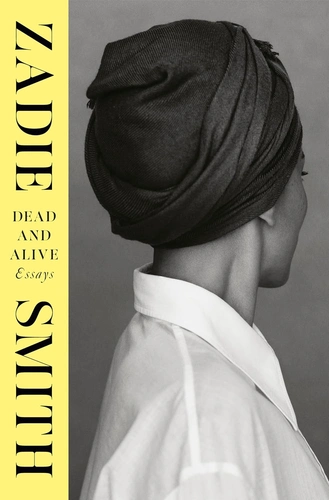
I found myself staring at an old photograph last week. My grandmother, young and laughing, holding a cat I never knew existed. The image was so full of life. But she is gone now. The cat is gone. The moment is gone. And all I have is this small, yellowing rectangle of paper. It felt insufficient. It felt like a lie. I wondered, can any container ever truly hold a life? Can art? Can memory? Can words? Zadie Smith’s new essay collection, Dead and Alive, seems to have been written for that exact question.
The Protagonist: A Mind Alive and Wrestling
The protagonist of this book is not a fictional hero. It is Smith herself. She is a mind in constant motion. She writes about attending a funeral for a friend, then turns to the joy of a perfect sentence in a novel. She describes the sterile feeling of a hotel room in a foreign city, then dives into the messy politics of her London neighborhood. She does not give you neat answers. She gives you her honest, searching thoughts, often mid-thought. You see her stumble. You see her change her mind. The core conflict is simple yet immense: how do you live fully when you know you will die? She explores this through art, through grief, through the absurdity of daily life. The suspense is not about plot. It is about whether she can find a way to hold both things at once. And I found myself holding my breath, waiting to see if she could.
The Craft: Light, Shadow, and the Space Between
Smith’s central theme is the tension between presence and absence. Life is presence. Death is absence. But she argues that great art lives in the space between them. Her key imagery is the photograph and the sentence. She compares writing a sentence to developing a photograph in a darkroom. You must be patient. You must wait for the image to emerge from the chemical bath. She writes about the perfect sentence in a novel by James Baldwin. That sentence, she says, does not describe the feeling of being alive. It is the feeling. It captures the light and the shadow in one breath. This is her craft. She breaks down the mechanics of writing with the precision of a watchmaker. But she never loses the soul. The universal pattern she reveals is this: we all try to freeze time. We take photos. We write things down. We tell stories. And Smith shows us that these attempts are always imperfect. They are always haunted by what they leave out. That haunting, she suggests, is what makes them beautiful.
The Letting Go: An Argument for Imperfection
The argument completes itself not in triumph, but in acceptance. Smith does not claim that writing can defeat death. It cannot. She does not claim that art is eternal. It is not. What she offers is more subtle. She argues that the act of trying to capture something is itself a form of living. The attempt matters more than the result. She writes about a failed painting she made as a young woman. It was a clumsy attempt at a portrait. The face was wrong. The proportions were off. But looking at it years later, she feels the love in the attempt. She feels the young woman who tried. The book’s cross-era resonance is strong. In an age of quick snaps and disposable content, Smith asks us to slow down. She asks us to make things, even if they are flawed. She asks us to be present, knowing we will be absent. The real emotion she leaves me with is not sadness. It is a strange, quiet relief. Maybe the goal is not to hold everything perfectly. Maybe the goal is just to try. And to keep trying, until the end.
