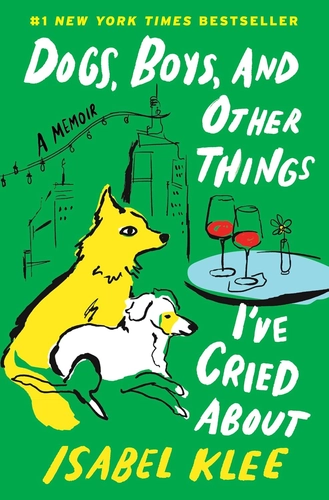
Isabel Klee’s memoir has a premise that sounds like a hundred other books. Twenty-year-old Jersey girl moves to a grungy Manhattan basement apartment, gets a job with a dog photographer, falls into rescue work, dates a parade of unsuitable men, finds herself. It is not that. Or, fine, it is that, but the framing changes everything. The dogs aren’t a subplot or a cute garnish on a coming-of-age story. They are the whole point.
What if the love we practice on animals is the love we should have been demanding from people all along?
The Woman Who Kept Saying Yes to the Wrong Things
Klee is honest in a way that occasionally made me wince on her behalf. She writes about fickle boyfriends, parties she barely remembers, friendships that shifted under her feet. She also writes about Simon, the fluffy puppy rescued from the meat trade who became her anchor, and about the foster dogs she took in one after another, each with its own damage and its own timetable.
The core conflict is quiet but real. Klee wants a romantic love that will feel as steady as what she has with Simon. She keeps looking for it in men who are kind enough, charming enough, present enough. One of her sharpest lines is essentially that a man being nice to you does not make him your person. That landed hard.
What makes her struggle suspenseful is that she doesn’t know yet what she’s learning. She’s living it. The reader sees the pattern before she does, and that gap between her experience and our vantage point generates genuine tension. I won’t tell you how it resolves. I’ll just say the resolution is not the one you’re braced for.
Love and Patience, and What They Actually Fix
Klee proves repeatedly that love plus patience can heal a broken creature. A terrified foster learns to eat from her hand. A dog with a bite history learns to trust a leash. The evidence accumulates until you believe her completely.
Then she turns the same formula on the men in her life, and the book gets uncomfortable. Her observation, roughly, is that love and patience can heal a broken dog but usually won’t heal a broken man. I sat with that sentence for a while. It’s a little unfair as a generalization. It’s also the kind of unfairness that comes from lived experience rather than argument, and I found I couldn’t dismiss it.
The imagery does a lot of quiet work here. Klee returns again and again to the physical details of care: the gait you learn to read, the paws sensitive to touch, the treat refused. She’s arguing that attention is a form of love, maybe the purest one available to us. You know your dog is hurting because you paid attention. Nobody taught you. You just watched.
The timeline jumps in a few places and I lost my footing, briefly, about when things were happening relative to each other. It’s a small complaint. It doesn’t sink anything.
The Kind of Book That Feels Like a Friend Talking
The book is genuinely well written, which surprised me. I’ve been burned before by influencer memoirs that turn out to be three hundred pages of captions. Klee can construct a scene. She can end a chapter.
We are living through a period where a lot of people my age report that their closest relationship is with an animal. The book doesn’t judge that. It also doesn’t pretend it’s a complete substitute for human connection. Klee wants both, and the honesty of that wanting is what makes the book feel like a friend talking rather than a brand speaking.
Read this if you have ever loved a dog and lost one, or if you foster, or if you spent your twenties in a city making bad romantic decisions. Skip it if you need tight chronology, or if you genuinely dislike dogs. The book cannot help you. Nobody can.
It won’t fix your dating life. It might make you feel slightly less strange about crying in your car after a vet appointment, and honestly, that’s not nothing.

