When Thinking More Starts Making Things Worse
Thinking can help us solve problems, but there is a point where more thinking stops being useful. You replay something that happened earlier, imagine what could go wrong, question your decisions, and then return to the same thoughts without reaching an answer.
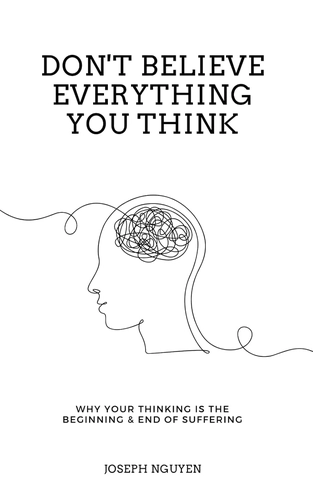
Don’t Believe Everything You Think by Joseph Nguyen focuses on this pattern. Instead of teaching readers how to analyze every thought more effectively, the book takes a different position: not every thought deserves to be believed, examined, or followed.
That idea makes the book particularly relevant to people who feel mentally exhausted from constantly trying to figure everything out.
Thoughts Are Not Always Facts
One of the simplest ideas in the book is also one of the most useful. A thought can feel completely convincing without being an accurate description of reality.
If someone does not reply to your message, your mind may immediately create an explanation. You might assume they are upset, losing interest, or avoiding you, even though you do not actually know what is happening.
The thought feels real because you are experiencing it directly. But the book encourages readers to separate the thought itself from the facts surrounding the situation.
That small distinction can create some distance from unnecessary worry.
Why We Keep Feeding the Same Thoughts
Overthinking often feels like problem-solving. We tell ourselves that if we think about something long enough, we will finally understand it or find the right answer.
Sometimes that works. Often it does not.
You can spend hours analyzing a past conversation without learning anything new. You can imagine dozens of future scenarios without becoming any more prepared. The mind simply keeps producing another question, another possibility, or another reason to worry.
The book encourages readers to notice when thinking has stopped producing useful information and has become a repetitive mental habit instead.
You Do Not Have to Argue With Every Thought
Another useful part of the book is the idea that fighting negative thoughts is not always necessary.
People often try to replace every uncomfortable thought with a positive one. That can become exhausting in its own way because you are still giving the original thought your full attention.
A different approach is to notice the thought without automatically treating it as a command or a fact. You can have the thought that something will go wrong without immediately changing your behavior around it.
For anyone who struggles with mental loops, that can be a much more realistic approach than trying to maintain positive thinking all day.
What Makes Don’t Believe Everything You Think Worth Reading?
The book is short and easy to approach, which makes it different from many psychology books that require a lot of background knowledge. Its central idea is repeated in different ways, so readers can quickly connect it to familiar situations involving anxiety, self-doubt, and overthinking.
It is especially relevant when the problem is not a lack of information but an inability to stop mentally revisiting the same information.
The book does not suggest that people should stop thinking altogether. It is more interested in helping readers recognize when their thinking is creating additional distress rather than solving the original problem.
Who Should Read It?
This book may be useful for people who:
- Overthink conversations and decisions
- Constantly imagine negative outcomes
- Struggle to let go of past mistakes
- Need reassurance before making simple choices
- Find it difficult to switch off their thoughts
- Want a simpler way to understand negative thinking
Final Thoughts
Don’t Believe Everything You Think offers a straightforward idea for people who are tired of being pulled around by their own thoughts. You do not have to believe every prediction, assumption, or story your mind produces.
For readers dealing with overthinking and emotional exhaustion, that can be an important shift. Instead of trying to solve every thought, you can begin deciding which thoughts actually deserve your attention.

