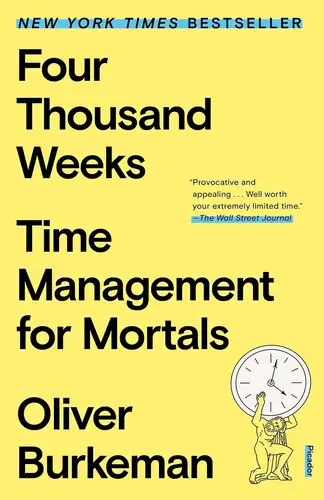
I was standing in my kitchen, staring at a half-empty coffee cup, feeling the familiar hum of anxiety about everything I hadn’t done yet. I had tried every productivity system. Bullet journals. Time blocking. The Pomodoro technique. The “eat that frog” method. Each one worked for about three days before the guilt returned, heavier than before. That’s when a friend handed me Oliver Burkeman’s Four Thousand Weeks.
The title itself was a punch to the gut. Four thousand weeks. That’s what we get. If you’re lucky. And I had spent so many of them trying to optimize my way out of the human condition.
Why the Protagonist Is You, the Reader, and Why That Hurts
Burkeman doesn’t write about a hero. He writes about you. About me. About anyone who has ever felt that sinking feeling when you look at your to-do list and realize it will never, ever end.
Here’s what I mean. He describes a person who wakes up each morning with the quiet desperation of someone who believes that if they could just find the right system, they could finally feel in control. This person tries to get through tasks quickly, to clear the deck, to finally get to the “real” life that’s waiting just around the corner. But the deck is never clear. The corner never comes.
I recognized myself so completely that I had to put the book down for a moment. He calls it the “efficiency trap.” The more efficient you become, the more demands arrive to fill the space. It’s not a bug. It’s a feature of modern life. We think we’re solving a problem, but we’re actually feeding a monster.
The core conflict is simple and terrifying: you will never feel caught up. And you have to decide what to do with that fact. I won’t tell you how Burkeman resolves it, because the resolution isn’t the point. The point is that the question itself is the only honest one.
The Dangerous Comfort of a Finite Life
Burkeman’s central argument, the one that made me uncomfortable for days, is that our obsession with time management is actually a way to avoid confronting our own mortality. We keep busy to keep from feeling the weight of our own finitude.
He uses a few key images that stuck with me. One is the idea of “keeping your options open.” We refuse to commit to anything because commitment feels like death. But here’s the thing: it is. Every choice to do one thing is a choice not to do a thousand others. And that’s the price of living.
I thought about my own life. The projects I’d started but never finished. The hobbies I’d bought equipment for but never practiced. The vacations I’d planned in my head but never booked. Each one was a way of pretending I had infinite time. Each one was a small lie I told myself.
Burkeman draws on philosophers like Heidegger and psychologists like Jung, but he doesn’t get academic about it. He keeps it grounded. He says that the only way out of the anxiety is to accept that you will fail. You will fail at most things. You will leave most things undone. And that’s okay. In fact, it’s the only way to be free.
The book isn’t about doing less. It’s about choosing what to fail at consciously. That’s a different kind of power.
What This Book Will Not Do for You
Here’s the honest truth. This book will not make you more productive. It will not give you a system to get more done. It will not make you feel good about your inbox.
What it will do is something stranger. It will make you feel slightly less alone in the constant, low-grade panic of never having enough time. It will give you permission to stop pretending that you can beat the system.
Burkeman has a few practical tools at the end, and I’ll be honest: some of them are useful. But the real gift of the book is the shift in perspective. He suggests asking yourself: “In what ways have you yet to fail to accept that you’re who you are, not who you think you ought to be?” I wrote that question down. I haven’t answered it yet. I’m still sitting with it.
Who should read this? Anyone who has ever felt like they’re running a race they didn’t sign up for. Anyone who has ever finished a day’s work and felt like they’d accomplished nothing. Anyone who suspects that the problem isn’t their system, but their relationship with time itself.
Who shouldn’t read this? People who are genuinely happy with their productivity systems and feel no anxiety about time. But I’m not sure those people exist.
The book is not perfect. It repeats itself. Some sections feel padded. The philosophical references can feel a bit name-droppy. But the core message is so honest, so refreshingly un-optimistic, that I found myself forgiving the weaker parts.
I finished the book and didn’t immediately change my schedule. I didn’t cancel my subscriptions or delete my apps. But I did something quieter. I sat on my couch for fifteen minutes and did nothing. I didn’t check my phone. I didn’t plan my next move. I just sat there, feeling the finite, precious, absurdly brief span of my life.
It wasn’t comfortable. But it was real.
