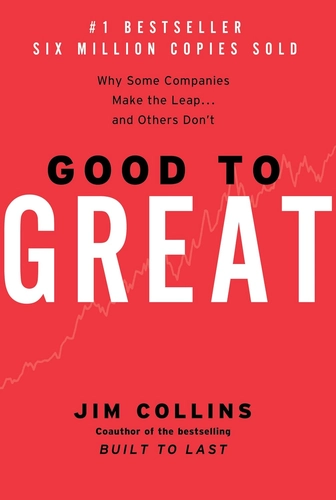
I picked up Good to Great with a fair amount of skepticism. Another business book promising a formula? Another guru with a three-step plan? I had seen the cover on countless desks, a corporate totem I associated more with airport bookstores than with actual insight. It sat on my nightstand for two weeks before I cracked it open, and honestly, I expected to skim a few chapters and move on.
But then I hit the section on Level 5 Leaders, and something shifted. Collins and his team spent five years analyzing 1,435 companies to find just eleven that made the leap from good to great and sustained it. What they found contradicted everything our culture tells us about leadership. The most successful leaders weren’t charismatic visionaries or aggressive risk-takers. They were quiet, humble, and relentlessly determined. I closed the book and stared at the wall for a minute. Was everything I believed about success upside down?
The Quiet People at the Top
The book’s central argument is this: greatness is not achieved through dramatic transformations or heroic geniuses. It comes from disciplined people, disciplined thought, and disciplined action, sustained over years. Collins calls it the flywheel effect. No single push creates the breakthrough. You keep pushing, the wheel turns slowly, then faster, and eventually it breaks through. The public sees the dramatic moment and calls it luck. Those inside know better.
Collins profiles leaders like Darwin Smith of Kimberly-Clark. Smith was a mild-mannered lawyer who became CEO and decided to sell the paper mills, the company’s core business for over a century. He endured ridicule and criticism, but he believed the company could become a consumer paper giant. He was right. Kimberly-Clark beat Procter & Gamble, its much larger rival, in stock returns by over four times. What struck me was not the strategy, but the temperament. Smith was described by one board member as “not flashy, just very, very consistent.” He didn’t seek credit. When things went well, he pointed out the window at his team. When things failed, he looked in the mirror.
This is the window and mirror concept. Great leaders deflect praise and absorb blame. It’s the opposite of what we see on television or in celebrity CEO culture. I’ll be honest, it made me uncomfortable. I realized I have spent a lot of my own career trying to look impressive, to sound decisive, to project confidence. The book made me ask a hard question: am I actually building anything, or just performing competence?
The Hedgehog and the Curse of Competence
The most difficult chapter for me was the Hedgehog Concept—the idea that great companies find the intersection of three circles: what you are deeply passionate about, what you can be the best in the world at, and what drives your economic engine. It sounds simple. It’s brutal. Because it forces you to admit what you are not good at, what you don’t genuinely care about, and what will never make you money.
I kept thinking about my own career choices. I had chased opportunities that looked good on paper but drained me. I had said yes to projects because they were prestigious, not because they aligned with my strengths. The book’s insistence on the “curse of competence” hit hard. Being good at many things is a trap. Greatness requires the discipline to say no, to focus on one thing until you are world-class, and to reject the seductive pull of opportunity.
Collins also discusses the Stockdale Paradox, named after Admiral Jim Stockdale, a Vietnam POW who survived eight years in captivity. He told Collins that the optimists, the ones who believed they would be released by Christmas, died of broken hearts. The ones who survived believed they would eventually get out, while also confronting the brutal reality of their present suffering. You must hold faith and face facts simultaneously. This reminded me of my own freelance years, the constant oscillation between hope and despair, the need to believe in the work while acknowledging that it might fail. It’s a tension I still struggle with.
What Holds Up, and What Doesn’t
The book is not without flaws. The companies Collins selected as “great” have not all remained so. Circuit City is bankrupt. Fannie Mae was a disaster. Collins addresses this in later editions, arguing that the research identified the principles that worked during the leap, not a guarantee of eternal success. It’s a fair point, but it does weaken the authority of the study. A methodology that picks winners in hindsight is easier to question when those winners later stumble.
Still, the core insights hold up. The emphasis on getting the right people on the bus before deciding where to drive is now common wisdom, precisely because it is true. The critique of technology as a savior, the reminder that it is an accelerator, not a driver, feels more relevant than ever. And the flywheel concept, the rejection of the “miracle moment,” resonates in a world that celebrates overnight success while ignoring the decade of quiet work behind it.
A Mirror I Didn’t Ask For
If you are building a company, leading a team, or even just managing your own career, this book will challenge you. It is not a feel-good read. It demands that you look at your own patterns of self-aggrandizement and ask whether you are building something that will outlast you. It is especially valuable for people who are competent, because it attacks the very thing they are proud of.
I would not recommend it if you want a quick motivational fix. There is no magic formula here, no secret sauce. The book is dense, data-heavy, and at times repetitive. It rewards patience. If you are not ready to examine your own ego, if you prefer the comfort of believing that success comes from genius or luck, this will frustrate you.
I finished Good to Great feeling less certain about my own habits, and more clear about what I need to change. It did not give me a checklist. It gave me a mirror. The question it leaves with me, and I suspect with you, is a simple one: what are you actually willing to be disciplined about, for years, without applause?

