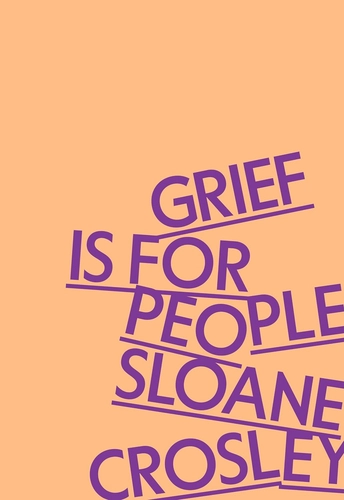
I found myself thinking about a friend’s earring recently. Not a valuable one, just a small silver hoop she lost at a party three years ago. She was devastated. Not because of the earring, but because of what it meant. She kept checking the couch cushions, the bathroom sink, the garden path. It was a small, pointless search. But she couldn’t stop. What do we do when we lose something that cannot be replaced? That is the question Sloane Crosley’s Grief Is for People asks, though it never quite answers it.
A Quiet Wedding and a Sudden Door
I went to a quiet suburban wedding last month. The bride’s mother, a woman I barely know, asked me how I was doing. I told her I was fine. But I wasn’t. I had just finished this book, and it had cracked something open in me. Grief Is for People is about losing a friend, a man named Russell, who was Crosley’s editor, her confidant, her compass. But it is also about losing a Tiffany necklace, a handbag, her sense of safety. The book opens with Crosley returning from vacation to find her New York apartment burgled. Her jewelry is stolen. She calls the police, files a report, and then, a few days later, Russell dies by suicide. Two losses, one material, one human, collide. The question becomes: Can we grieve the same way for a thing and for a person? And if we do, what does that say about us?
The Protagonist and Her Strange Search
The protagonist here is Crosley herself, a writer with a sharp tongue and a softer heart than she likes to admit. She is not a saint. She is irritable, funny, and sometimes petty. She tracks down her stolen jewelry through pawn shops and online listings, even as she is planning Russell’s memorial. It sounds absurd. It is. But that absurdity is the point. She describes the search not as a replacement for grieving, but as a way of doing grief. The core conflict is between the enormity of losing a person and the smallness of the rituals we invent to cope. She cannot bring Russell back. But maybe she can find her grandmother’s ring. The suspense is not about whether she gets the jewelry back. It is about whether she can survive the gap between what she needs and what she can have. I will not spoil the ending. I will only say that the search ends in a way that feels both unsatisfying and exactly right. It is a book about how grief does not resolve. It just changes shape.
The Strangeness of Loss and the Things We Hold
The core theme here is the strangeness of loss. Crosley does not write grief as a noble, quiet sadness. She writes it as a series of embarrassing, irrational impulses. She calls the police about the necklace. She argues with the insurance adjuster. She gets angry at Russell for dying. The key imagery is the stuff itself: the stolen jewelry, the empty apartment, the unread emails. These objects are not metaphors. They are the actual, physical edges of absence. Crosley’s craft is in making you feel the weight of these small things. A sentence about a missing earring can hit harder than a paragraph about a broken heart. She uses humor the way a doctor uses a scalpel: to cut precisely, to expose the wound beneath the laugh. The character’s struggle reveals a universal pattern. We all do strange things when we lose someone. We obsess over objects. We replay conversations. We search for things that cannot be found. This is not weakness. It is the only way we know how to stay close to what is gone.
The Honesty of Not Being Noble
I will be honest. I came into this book expecting a somber meditation on loss. What I got was something more valuable. Crosley completes her argument by refusing to make grief beautiful. She does not find meaning in Russell’s death. She does not turn her pain into a lesson. The book’s cross-era resonance lies in this refusal. In an age of tidy Instagram grief, of “healing journeys” and “light at the end of the tunnel,” Crosley offers something messier. She offers the truth. Grief is for people, she seems to say. It is not for saints. It is not for philosophers. It is for people who lose things and do not know how to get them back. Her honesty is more powerful than any heavy, poetic narrative. It makes you feel less alone in your own small, strange obsessions. I recommend this book to anyone who has ever searched for something they knew they would never find. To anyone who has felt foolish for grieving a thing, a moment, a person. Read it. It will not fix you. But it might make you feel seen.
