Molly Fitzgerald was two months old on September 11, 2001, when her mother went to an appointment at the World Trade Center and did not come back. She grew up loved, genuinely loved, by her father and the stepmother who raised her. And she grew up afraid.
Now an adult, she runs the Rhode Island Department for Emergency Preparedness. Her job is to rehearse the worst. Plane crashes, storms, epidemics, the moment when a normal Tuesday turns into the day everything changes. She is married to Jesse, a police polygraph examiner with his own history of crisis, a man who reads lies for a living and cannot always tell the truth about himself.
When does preparing for catastrophe become a way of avoiding the people standing right in front of you?
Molly Fitzgerald, and the Disaster She Cannot Outrun
Molly’s vigilance looks like competence from the outside. She saves lives on paper. But Picoult keeps showing the cost of that vigilance inside a marriage, inside a body. Molly maps disasters so precisely because she has never stopped being the infant in the story, the one whose mother vanished without explanation.
The book moves between Molly’s present and her mother Eloise’s past, and the middle section is where it gets genuinely hard to read. Eloise, living with bipolar disorder, has a baby. Then severe postpartum depression arrives, and with it a fear so specific and so awful that I had to put the book down twice. She becomes convinced she may have already harmed her daughter. She leaves, believing her absence is the safest gift she can give.
I will not tell you what happens. I will tell you that the twist landed on me like a hand on my shoulder.
Hollow Bones, and Why Fragility Is the Whole Point
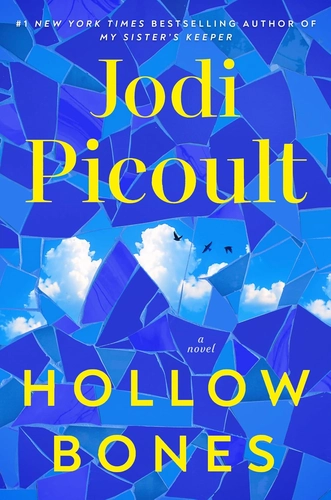
The title comes from birds. Robin bones are hollow, which sounds like a weakness until you understand that hollowness is exactly what allows flight. Picoult returns to this idea quietly, never hammering it, and it becomes the book’s argument: the same structure that makes a creature breakable is the structure that lets it rise.
That is not a decorative metaphor. It is the thesis. Eloise’s illness makes her fragile and also makes her capable of a kind of love that a healthier person might never have to invent.
The Philippe Petit material, the aerialist who walked between the Twin Towers in 1974, sits a little awkwardly against the domestic story, at least for me. It is beautiful and it does connect, a man suspended over an abyss with no net, trusting balance. But I found myself rushing through those pages to get back to Eloise.
The stronger thread is smaller. A bathroom with no running water. A mosaic Eloise worked on there, tile by tile, because you cannot fix a broken thing all at once. You place one piece, then another.
Picoult’s real subject is the medical system’s failure of imagination. She does not make Eloise a villain. She makes her a woman whose condition was dismissed, under-researched, and treated as a hormonal inconvenience. If postpartum psychosis happened to men, she suggests, the research budget would look very different.
The Question That Doesn’t Get Simpler
Read Hollow Bones if you want a novel that treats moral ambiguity as a genuine puzzle rather than a plot device. The characters are layered, the timelines are handled with real skill, and the author’s note at the end is essential, not optional.
Do not read it if you are currently in the middle of postpartum recovery, or if psychiatric hospitalization, infant harm, or 9/11 imagery are live wounds. This is not a book that offers distance. It sits close.
I keep thinking about Eloise leaving because she believed it was the right thing, and how the right thing and the wrong thing can wear the same coat. Twenty-five years after 9/11, in a country that has built an entire industry around preparing for the next bad day, that question has not gotten simpler.
This book will not tell you whether to forgive Eloise. It will make you sit with her a while longer than is comfortable. Some nights that is exactly what I need from a novel. You might too.

