I have a friend who, after a car accident, spent three years learning to walk again. She told me once, in a quiet voice, that the hardest part wasn’t the pain. It was everyone else’s pity. They looked at her like she was already gone. I thought of her constantly while reading Johanna Hedva’s How to Tell When We Will Die: On Pain, Disability, and Doom. The book opens with a question that feels almost rude: what if your body is not a vessel for a life, but a sentence you cannot escape? Hedva, a Korean American writer and artist who lives with chronic illness, does not offer a tidy answer. She offers something more unsettling. She asks: who gets to decide what a livable life looks like?
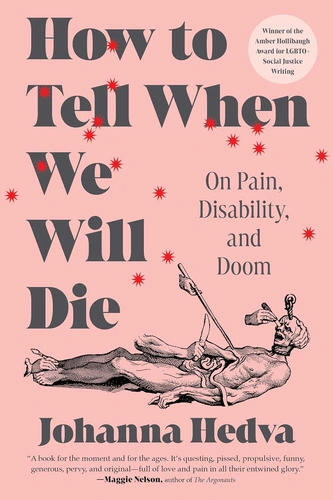
The book is a collection of essays, but it reads more like a long, careful argument with the world. Hedva’s central figure is the “disabled body” — a body in constant negotiation with pain, with systems, with time itself. She rejects the popular narrative that disability is a tragedy or a test. Instead, she treats it as a form of knowledge. To be in pain, she argues, is to see the world from a place most people refuse to look. The core conflict here is not between Hedva and her illness. It is between her and a culture that insists on health as a baseline, a right, a moral good. She writes about hospital rooms, about the exhaustion of explaining yourself to doctors, about the strange loneliness of being in a body that alarms others. There is no dramatic victory. No cure. What emerges, instead, is a kind of defiant clarity. The book’s thesis, I think, is this: our obsession with predicting death — with knowing “when” — is really a way to avoid the harder question. How do we live with the body we have right now, broken or not?
Hedva’s prose is sharp, almost surgical, but never cold. She weaves personal narrative with philosophy, referencing thinkers from Frantz Fanon to Susan Sontag, but always returning to her own experience. One image stayed with me: she describes lying on a couch, unable to move, watching the light shift across the ceiling. It is a small, quiet moment. But Hedva makes it feel monumental. She shows that pain is not just a sensation. It is a world. It has its own weather, its own rules. The key imagery here is of doom — not as a distant catastrophe, but as a constant companion. She writes that living with chronic illness is like living in a perpetual state of low-grade apocalypse. The news cycle tells you disaster is coming. For her, it has already arrived. This is the book’s deepest insight: the disabled body is not a symbol of failure. It is a revelation. It exposes the lie that “normal” is neutral. Normal is a privilege. Normal is a structure that excludes, quietly, constantly.
There is a moment near the end where Hedva writes about hope. Not the saccharine kind, not the “everything happens for a reason” kind. She describes hope as a practice. A muscle you exercise even when you are sure it has atrophied. I found this both painful and oddly comforting. The book has its limitations. It is dense, and at times it feels like Hedva is writing for an academic audience, not a general one. Some readers might wish for more practical guidance, more concrete steps. But that is not her project. She is not a self-help guru. She is a witness. And what she witnesses, she names with precision. I finished the book feeling something I did not expect: not despair, but a strange quiet. Maybe that is what the book really offers. Not answers, but permission. Permission to stop pretending that suffering is an exception. Permission to sit with the brokenness, yours and everyone else’s, and still call it living. I recommend this book to anyone who has ever felt alienated by their own body. To anyone who has ever wondered what it means to be okay when you are not okay. It will not fix you. But it might help you see.
