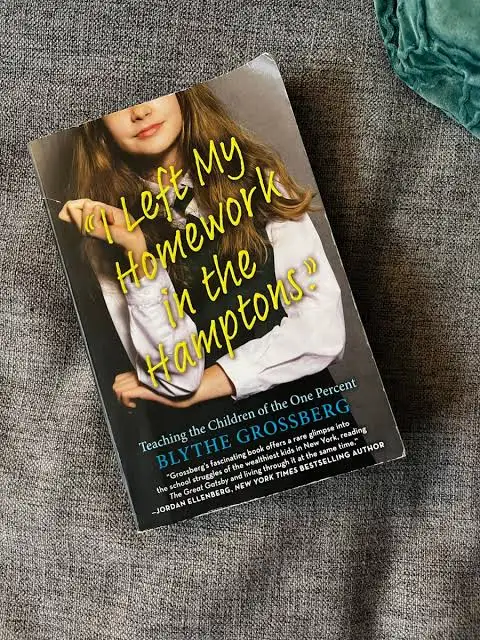
You pick up a book expecting a voyeuristic peek into a world of champagne wishes and caviar dreams. By page three, A jolt of recognition knocks the wind out of you, because those stories are all your own. That was I Left My Homework in the Hamptons for me.
It’s a slim little thing, perfect for a tote bag or a nightstand. I devoured it in two evenings. This isn’t a tell-all about penthouse views and private jets. The book follows a Harvard-trained psychologist who spends her days tutoring Upper East Side kids and her nights squeezing onto the subway, heading back to her modest apartment to help her own son with his learning challenges, build LEGO castles, and tuck him into bed. She has the exact same grind as every other city dweller, yet every morning she walks through a door into an entirely different universe.
That double life alone is gripping enough. What really caught me off guard, though, was how brutally honest this book is, and how unexpectedly tender.
The gilded cage is still a cage.
Grossberg introduces us to her students: kids who have everything except the freedom to fail. There’s the boy who can barely read but is expected to ace an interview for an elite kindergarten. There’s the girl who writes beautiful essays but crumples them up in anxiety because they never meet her parents’ standards.
The scene that hit me hardest: a student finally writing about his grandma’s terrible pancakes—the first thing he’d ever written with actual warmth, because it wasn’t impressive. Grossberg doesn’t paint the wealthy parents as villains. Those parents aren’t cartoonishly cruel; they’re terrified. Terrified their kid will fall behind, terrified of being judged by their social circle, terrified that all this money and access still won’t buy their child a happy life.
She walks us through the absurd theater of kindergarten admissions, where a five-year-old’s schedule looks like a CEO’s calendar, and sprawling apartments become gilded cages of anxiety. You’ll laugh, but somewhere along the way that laugh catches in your throat, because beneath the designer clothes and private tutors, you see the same desperate, clumsy, over-the-top love that any parent recognizes.
Boredom might be the most expensive gift you can give.
The real magic happens when Grossberg starts pushing back. She’s a product of this elite system herself, Ivy League degree and glossy resume, yet she’s deeply skeptical of its core beliefs. She keeps coming back to this idea of a growth mindset: kids need to understand that their abilities can grow through effort, rather than being chiseled in stone.
If you never let them fall, they’ll never learn how to get back up. There’s a passage I reread three times, where she encourages a student to write about something ordinary: a regular family dinner, walking the dog, arguing with a sibling, instead of a lavish Caribbean vacation. Her argument is that a little boredom, a little waiting, a little not getting everything right away, is actually a wildly underrated gift.
These wealthy kids are so lifted up by resources that they’re petrified of falling, and that fear is more draining than any failed test. Reading those pages, you feel this enormous release: what a relief it is to be allowed to be ordinary, to mess up, to feel lousy and still be okay. Grossberg’s prose is light, each sentence a quiet whisper: pause, and look at what you already have that money can’t buy.
This book isn’t a guide to getting into Harvard. It’s a guide to not losing yourself along the way.
Why should you read this book? Not because you need to decode the secrets of Upper East Side admissions, but because it’s about you and me. It’s about the pressure we pile on ourselves, the quiet competition we feel in our own circles, the 2 AM voice that whispers “you’re not doing enough.” Whether you live in a penthouse or a rented one-bedroom, the core struggle is the same: how do we raise kind, resilient, genuinely happy people in a world that feels relentlessly competitive.
Grossberg’s voice is so candid and unpretentious. She feels like a smart friend chatting over coffee, not a professor lecturing from a podium. She reminds you that the grass isn’t always greener, and that some of the most valuable things—time, patience, the freedom to screw up—are actually free. This isn’t the kind of book that rewires your life in one reading. But by the last page, you’ll realize you’ve been breathing more easily than when you started.
Every parent, every kid, every one of us is just stumbling along in our own lane, doing our best. So pick it up. I bet you’ll spot a familiar, slightly flustered, beautifully real shadow in those glossy hallways.