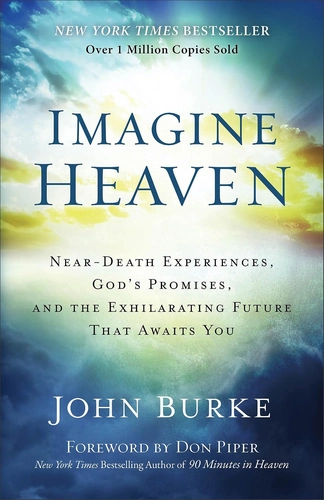
I found Imagine Heaven on a Tuesday night, three weeks after my mother’s diagnosis. I was scrolling aimlessly, looking for anything that would quiet the noise in my head. The title felt presumptuous. Who does John Burke think he is, claiming to imagine heaven? I almost put it down.
But I kept coming back to one thing. Burke isn’t claiming to have died. He’s a pastor who spent years collecting over one hundred near-death experiences from doctors, professors, bank presidents, atheists, people of every religion, and even a woman blind since birth. Then he did something I’ve never seen another author do. He placed those accounts side by side with what the Bible actually promises about heaven, and let them speak to each other.
The central argument of this book—the spine that holds every chapter together—is this: if thousands of unrelated people across cultures and centuries describe the same place with the same details, and those details match scripture, maybe we should pay attention. Maybe death isn’t the end. Maybe it’s a doorway.
The Stories That Changed How I See Everything
The accounts in this book are not vague. People describe colors that don’t exist on earth. They describe meeting loved ones who appeared young and whole. They describe a life review where they felt every consequence of their actions—not as judgment from God, but as honest self-awareness. One man who was blind from birth described seeing his caregivers’ faces for the first time, and he knew them instantly by love, not by sight.
What struck me most was the consistency. A Hindu woman described meeting a being of light who radiated unconditional love, and she later recognized that being as Jesus. An atheist surgeon, dead on the table for several minutes, came back and said, “I was wrong. There’s something after this.” People who had nothing to gain and credibility to lose—medical professionals, academics—risked their reputations to tell these stories.
But here’s what I need to be honest about. The book has its uncomfortable edges. Burke doesn’t shy away from accounts of hell, and those chapters are hard to read. He also acknowledges that NDEs are not the Bible. They’re complementary, like adding color to an existing painting, but they should never replace scripture as the foundation. Some readers might find the heavy biblical referencing tedious if they’re not familiar with the text. For me, it helped anchor everything.
The most powerful moment came when I sat beside my mother in her final weeks. She was weak, eyes mostly closed, barely present. I told her about the blind woman who could suddenly see. I told her about the reunions with parents and pets. Her eyes opened wide—the widest they’d been in days—and she stared at me with total attention. She passed two days later. I believe she went toward something beautiful.
What the Book Gives You, and What It Can’t
This book won’t convert you through argument alone. It won’t prove heaven exists in a laboratory sense, and Burke would be the first to say that faith still requires a step into the unknown. If you’re looking for a purely skeptical investigation of NDEs, this isn’t that book. It’s written from a Christian perspective, unapologetically.
What it will do is give you a vocabulary for hope. It will show you that people who have been there describe the same God of love that scripture describes. It will make you think about how you’re living today, because the life review accounts suggest that what matters most is how well we loved others. That’s a hard thing to sit with. It certainly confronted me.
People grieving will find something here, absolutely. People afraid of dying, yes. People who are curious about spirituality but suspicious of organized religion, maybe—if they can tolerate the biblical framework. If you want a purely secular analysis of NDEs, look elsewhere. If you’re comfortable in your certainty, this book might unsettle you.
I still have questions. I don’t fully understand how a Hindu woman meets Jesus or why some people experience darkness instead of light. Burke doesn’t pretend to have all the answers either. He offers what he has: a collection of testimonies that point in the same direction, and an invitation to consider that the direction might be real.
This book won’t eliminate your fear of death overnight. But it will make you feel less alone in the waiting. It will give you images to hold onto when the night feels long and the silence feels permanent.
And if you’re lucky enough to sit beside someone you love as they take their last breaths, it will give you words to offer them. Words that might make their eyes open wide one last time.
That alone was worth everything to me.

