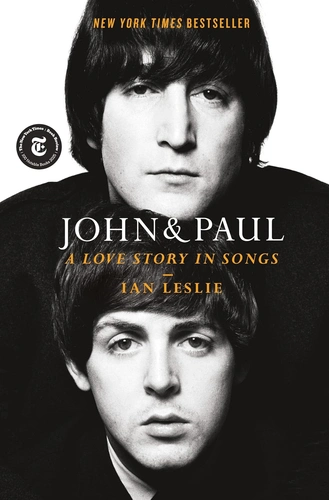
I was sitting in a friend’s kitchen last week, listening to “Hey Jude” on an old record player. The needle crackled. My friend said, “You know, Paul wrote this for John’s son.” I didn’t know that. It made me wonder: How do two people, so different they sometimes couldn’t stand each other, create something that outlives them both? Ian Leslie’s John and Paul: A Love Story in Songs tries to answer that. It’s a book about music, sure. But really, it’s a book about us. About the messy, beautiful, exhausting work of making something with another person.
The Two Sides of a Coin
Leslie paints John and Paul not as gods, but as two very human men. John was the sharp one, the cynic who cut through the noise. Paul was the craftsman, the one who polished a song until it shined. They fought. They envied each other. John thought Paul’s songs were too pretty. Paul thought John’s were too raw. But here’s the thing: they needed each other. Leslie shows us this through the songs themselves. He picks apart the lyrics, the chord changes, the way one voice would rise where the other fell. I’ll be honest, I didn’t expect to feel so moved by a book about a band I thought I knew. But when Leslie describes the writing of “A Day in the Life” or “I Want to Hold Your Hand,” he doesn’t just explain the music. He shows the relationship. The core conflict? It’s not about who was better. It’s about what happens when two people push each other to the edge, and somehow, the edge becomes the best place to create from. I won’t spoil the ending of their story. You know how it ends anyway. But what matters is what they built together, not how it fell apart.
The Light in the Friction
The core theme here is this: collaboration is not about harmony. It’s about friction. Leslie uses light and shadow imagery throughout the book. He talks about the “subtle light” that emerges when two conflicting voices find a single note. For example, he describes “We Can Work It Out” as a song where John’s impatience and Paul’s optimism literally argue with each other. John sings “Try to see it my way,” and Paul answers “Life is very short.” They’re not agreeing. They’re wrestling. And from that wrestling, something luminous appears. This character’s struggle, John and Paul’s struggle, reveals a universal pattern. I think about my own friendships, my own collaborations. The times I held back because I didn’t want to argue. The times I gave in to keep the peace. Leslie suggests that’s the wrong approach. The best work, the most alive work, comes from the friction, not the comfort. The book’s craft is subtle. Leslie doesn’t tell you to feel this way. He lets the songs speak. He lets the details, a late-night phone call, a half-written verse on a napkin, build the argument. It felt like watching a slow sunrise. You don’t see it happening, but suddenly, there’s light.
What We Carry Away
What I keep thinking about, days after finishing the book, is the idea that John and Paul’s partnership was a kind of love. Not romantic love. A different kind. The kind where you see someone’s flaws and you don’t look away. The kind where you push because you believe in what they could be. Leslie doesn’t sugarcoat it. He shows the pettiness, the jealousy, the moments when one wanted to quit. But he also shows the moments when, despite everything, they found each other in a song. This book is for anyone who has ever worked with another person. For anyone who has felt the tension of wanting to be right, but also wanting to create something good. It has a few slow patches, honestly. Some sections on chord theory I skimmed. But the real emotion, the one that stays, is this: Maybe the best partnerships are not the ones that flow easily. Maybe they are the ones that ask you to be your best, even when it hurts. I closed the book and put “Let It Be” on. And for the first time, I heard the argument in it. The light in the friction. I think that’s what Leslie wanted us to hear.
