Live Like a Philosopher Book Review: Your Brain Already Knows What It Needs
I woke up at 3 AM last Tuesday and did something stupid. I grabbed my phone and checked Instagram, then my email, then the news. By 3:45 I felt worse than I did before I went to bed. I told a friend about this the next morning, and she laughed. She said, “You know, the Stoics had a word for that.” I doubted it. I really did. But I picked up this book anyway, mostly because the title sounded like a dare.
The three authors, Massimo Pigliucci, Gregory Lopez, and Meredith Alexander Kunz, are practicing Stoics. They are also academics who seem to have gotten tired of philosophy living only in classrooms. Their central question is not “What is the meaning of life?” but something more immediate: “What do I do at 3 AM when my brain is a disaster?”
So here is my question after reading it: What if the most useful philosophy is not the one you study, but the one you use to get through a Tuesday night?
Character and Plot: The Protagonist Is You, and That Is Uncomfortable
The book does not have a traditional protagonist. That sounds like a flaw, but it is actually the point. The protagonist is you. Each chapter is a self-contained tool for a specific problem. You want to know how to handle anxiety? Go to Epictetus. You want to figure out if you are chasing the wrong things? Go to Aristotle. You cannot sleep because of existential dread? Go to Epicurus, who apparently had a lot to say about which worries are worth keeping.
I found myself resisting the book for the first thirty pages. I thought, “This is too simple. Life is not a flowchart.” But then I realized the simplicity is the craft. The authors break down each philosopher’s core idea into a four- or five-step process. They tell you what to ask yourself, what to try, how to fail, and then what to do when you fail. The emotional tension comes from the fact that you, the reader, have to do the work. There is no passive consumption here.
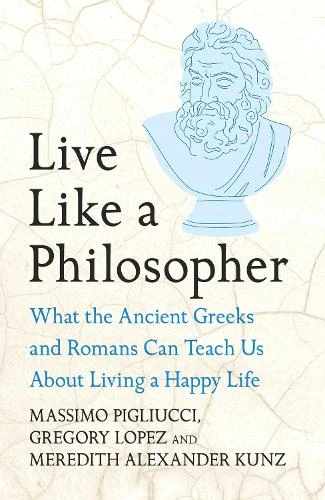
The conflict is between who you are and who you want to be. And the authors never promise a happy ending. They promise a more honest one. I will not spoil the conclusion, because honestly, you have to write it yourself.
Theme and Imagery: The Core Theme Is Choice, and the Key Imagery Is a Toolbox
The core theme of the book is agency. The authors argue that modern life trains us to be passive. We consume media, we scroll, we react. Ancient philosophy, by contrast, trains us to choose. The key imagery is the toolbox. Each philosopher’s system is a specific tool for a specific job. Epicurus is for when you need to ask, “Is this worry actually useful?” Aristotle is for when you need to ask, “Am I becoming the person I want to be?”
The most striking part for me was the chapter on Epicurus and anxiety. I always thought Epicurus was about pleasure. You know, wine and food and avoiding work. But the authors reframe him. They argue that Epicurus was actually asking: “When is anxiety worth the cost?” That question hit me hard. I realized I spend a lot of energy worrying about things that I cannot change. And that worry does not help me. It just exhausts me.
The authors do not try to convert you to Stoicism or any one school. They present each philosophy as a hypothesis. Try it for a week. See if it works. This is the universal pattern: we all need a system to make sense of our chaotic inner lives. The book is a map of those systems, but you have to walk the path.
Elevation and CTA: What You Get After You Finish
The book has flaws. It can feel like a self-help manual at times, and the step-by-step structure can feel rigid if you prefer loose thinking. But I think that rigidity is intentional. When you are in crisis, you do not want poetry. You want a procedure.
What I got from the book is a new vocabulary for my own behavior. I used to think I was just “anxious” or “lazy.” Now I can say, “I am prioritizing short-term pleasure over long-term meaning.” That is a different diagnosis. It points to a different cure. The book is for anyone who has ever felt stuck, or who has ever woken up at 3 AM and wondered why they feel empty.
The deeper question the book leaves me with is this: What if the ancient philosophers were not smarter than us, but just more honest about the fact that being human is a constant struggle, not a problem to be solved?
