I first read this book on a Greyhound bus between Chicago and Minneapolis, somewhere around mile 200, and I remember the exact sensation of my own life becoming suddenly, embarrassingly small. Here was a man who lost his pregnant wife, his parents, his entire professional identity, and he was not writing about revenge or despair. He was writing about meaning. I closed the book and stared out the window at the flat Illinois farmland and thought: if he could find a reason to keep going in a place designed to erase him, what exactly is my excuse for the days I spend feeling sorry for myself?
The question that haunts me, and the one this book forces every reader to confront, is this: if everything you love were stripped away tomorrow, would you still have a reason to get up?
The Man Who Watched Men Decide to Live or Die
The first half of the book is not what you expect. It is not a catalogue of atrocities, though the horrors are there. Frankl writes about the camps with the clinical detachment of a psychiatrist who is also, somehow, a participant. He describes the stages prisoners passed through: the initial shock, then the apathy that protected them from feeling too much, and finally the bitterness of liberation that never felt like liberation at all. He tells us about the man who stopped smoking because he had given up, and the men who kept their last cigarette for the day they would walk free. Some of those men never walked free. The cigarette was never smoked.
What struck me most was his observation that survival depended on something almost absurdly simple. The prisoners who had a future to return to, a manuscript to finish, a wife to see again, a task left incomplete—those were the ones who lasted. The ones who had nothing to live for died quickly, often of nothing more than a cold. Frankl watched men walk into the electrified fence because they had stopped believing there was any point. He watched others share their last scrap of bread. The difference between them was not physical strength or even luck. It was meaning.
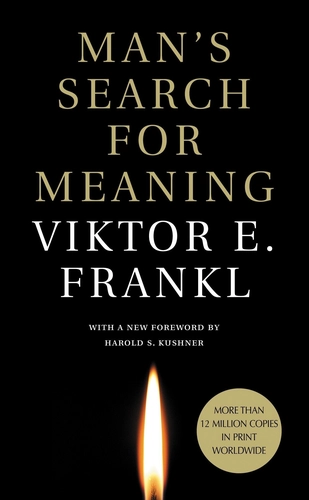
I do not mean to make this sound neat. It is not neat. The second half of the book, where Frankl explains his theory of logotherapy, is denser and harder to get through. Some readers find it dry. I found it necessary, because this is where he makes his argument explicit: we do not ask life what it owes us. Life asks us what we owe it. He flips the entire question of suffering upside down. It is not about why this is happening to me. It is about what I am going to do with what has happened.
The Last Human Freedom
The core image of this book, for me, is the one Frankl returns to again and again: a man standing in the freezing dawn, in rags, in the mud, and choosing, in that moment, what his attitude will be. Everything else has been taken. His family is dead or scattered. His work has been destroyed. His body is failing. But the one thing no one can take is his ability to decide how he will face it. That is the last human freedom. Frankl does not pretend this is easy or that it always works. He just insists that it is real.
There is something almost unbearable about reading a book that tells you suffering can be meaningful, when you know that millions of people suffered and died without any meaning at all. Frankl is careful here. He says meaning is not found in suffering itself, but in the attitude we take toward it. He quotes Nietzsche: he who has a why to live can bear almost any how. But he also admits that some prisoners did not have a why, and they died. The book does not resolve this tension. It simply holds it.
What This Book Gives You
What this book gave me, and what I think it gives most readers, is not comfort. It is a kind of clarity. The clarity is painful, but it is also freeing. If I can’t control what happens to me, I can at least control what I do with it. That is not a small thing. It is, Frankl argues, the only thing that matters.
Anyone going through something they cannot fix should read this. Anyone who has lost a job, a relationship, a belief, a person should read this. Anyone who has ever felt that life is pointless and wants to argue with that feeling should read this. If you want easy answers or want to be told that everything happens for a reason, skip it. This book does not say that. It says something harder: everything happens, and you get to choose what it means.
The afterword by William Winslade includes a story about Frankl in his later years, visiting with students who asked him what advice he would give. He told them to stop asking for advice and start asking themselves what life expected of them. I think about that a lot. I think about the bus ride, and the farmland, and the strange peace that came from realizing that my problems were not the center of the universe. They were just my problems. What mattered was what I did with them.
This book will not fix you. It will not make your pain go away. But it might, if you let it, give you a reason to get up tomorrow. And sometimes that is enough.

