I was talking to my grandmother last week, the one who still keeps a faded photograph of a ship. She pointed at a young woman on the deck. That could have been you, she said, if your great aunt had married a different man. It sounded dramatic but I felt it. A single yes or no, a ticket bought or not, and an entire bloodline shifts.
Rachel Cockerell’s Melting Point: Family, Memory, and the Search for a Promised Land is built around that same shudder. The book traces the early 1900s Galveston Movement, a forgotten plan to divert Jewish immigrants from Ellis Island to Texas. But Cockerell does not write a dry policy history. She walks through it using her own family, their letters, their silences. The question at the center is simple and crushing. What happens when the story you were told about your family turns out to be only half the truth?
The Protagonist Who Carries the Map and the Wound
Cockerell’s central figure is her great grandfather, a man who believed in the American dream with a kind of fierce, almost painful hope. He was a Zionist in his heart but a pragmatist with his hands. He helped organize the Galveston plan. He wanted Jews to leave the crowded tenements of New York and settle on the wide open plains of Texas.
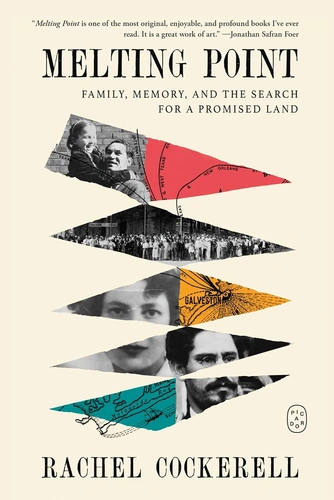
I found myself holding my breath as I read about him. He is not a hero. He is a man who made promises he could not fully keep. The core conflict is not with a villain but with time itself. Memory fades. Documents burn. The people who knew the truth die. Cockerell goes to archives, to dusty attics, to the homes of distant cousins. She finds contradictions. Her great grandfather wrote glowing reports about Texas. But the letters from the actual immigrants tell a different story. Loneliness. Drought. A longing for the Yiddish theaters they left behind.
The suspense here is not about plot. It is about identity. Will the author find a version of her family she can live with? Or will she discover that the past is a room with no door?
The Theme of Fragile Roots and the Dust of Texas
The core theme is not migration. It is the price of saying yes to a new place. Cockerell shows how every immigrant loses something. A language. A recipe. A joke that cannot be translated. The key imagery is the land itself. Texas is not a soft place. It is hard, red, dusty. The author describes the ground as a thing that holds no memory of the people who walked on it.
I kept thinking about a small detail. One immigrant family brought a single book with them. A prayer book. But the Texas wind tore the pages out. That image stayed with me. What do we carry when the wind takes the rest? Cockerell’s craft is quiet. She does not shout. She lets the letters speak. She lets the silence between the letters speak louder.
This character’s struggle reveals a universal pattern. Every family has a story that was sanded down, polished, made smooth. We tell ourselves we came from strong people who chose wisely. The truth is often messier. They chose out of exhaustion. They chose because the boat was leaving. They chose because they ran out of other options.
The Elevation and the Recommendation
I finished this book on a Sunday afternoon. I sat on my porch and watched a neighbor water her plants. She did not know me. I did not know where her parents were born. But I suddenly felt a connection. We are all products of a thousand small, forgotten decisions.
Melting Point resonates across eras because migration is not over. It is happening now. On our borders. In our cities. In the stories we tell about who belongs and who does not. Cockerell’s book has one flaw. It sometimes gets lost in the family tree, a branch here, a cousin there. I had to reread a few pages to remember who was who. But that is also its strength. History is not clean. It is a crowded room.
The recommendation is this. Read it if you have ever wondered about the road not taken. Read it if you have a family story that feels too neat. Read it if you want to understand that the people who came before you were not statues. They were tired, scared, hopeful people who made a guess about the future and hoped it would hold.
Maybe that is what memory really is. Not the photograph on the wall. But the hand that held the photograph, trembling, as it decided to pack or to stay.
