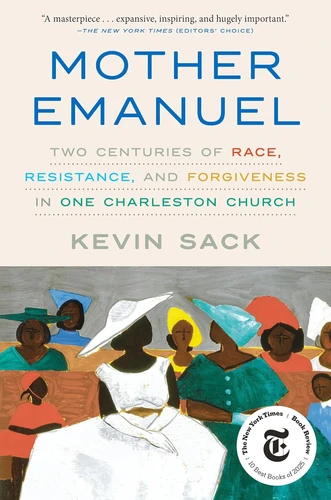
I have a confession. When I first heard about “Mother Emanuel: Two Centuries of Race, Resistance, and Forgiveness in One Charleston Church,” I thought I knew the story. A white gunman walks into a Bible study. Nine Black parishioners die. The families forgive him in court. A tragedy, yes. A story of grace, yes. But what else could there possibly be?
That was my mistake. And Kevin Sack’s book exists to correct exactly that kind of lazy thinking.
What We Think We Know
I live in a city with old churches. I walk past them without thinking. They are just buildings, right? Stone and glass and wooden pews. But what if I told you that a single church could hold the entire history of a country inside its walls? What if the same building that sheltered enslaved people in 1818 also hosted civil rights strategy sessions in the 1960s and a massacre in 2015?
That is the question Kevin Sack asks. Not directly, you know. He does not shout it. He just lays out the history of Mother Emanuel African Methodist Episcopal Church in Charleston, South Carolina, and lets the weight of it crush you slowly.
The Church That Would Not Die
The protagonist of this book is not a person. It is a place. Mother Emanuel itself.
Sack traces its roots to the early 1800s. Back then, Charleston had strict laws. Enslaved and free Black people could not gather without white supervision. But they gathered anyway. Denmark Vesey, a free Black man, was a member. He planned a rebellion. It failed. The church was burned to the ground.
I sat with that for a while. The first church was not destroyed by accident. It was destroyed by white fear.
But the congregation rebuilt. Again and again. Fires, earthquakes, segregation, the Civil War. Every time the building was knocked down, someone put it back up. That stubbornness, that refusal to disappear, is the core of the book. Sack does not romanticize it. He just shows you the receipts.
Then comes 2015. Dylann Roof. Nine dead. And here is where Sack does something smart. He does not dwell on the shooter. He barely gives him space. The real story, he shows, is what the survivors did next. They forgave. Not because it was easy. Because that is what this church has always done. It holds grief and grace in the same hands.
The Weight of a Wall
The core theme of this book, I think, is that a place can remember in ways that people cannot.
Sack writes with a journalist’s precision. He does not overreach for poetry. But there is a subtle light in his prose, a quiet attention to detail. He describes the stained glass windows, the wooden pews, the way the light falls on a Sunday morning. And he shows how each detail carries history.
For example, the church’s location. It sits on Calhoun Street. John C. Calhoun was a white supremacist politician. The street was named after him. The church sat there for two centuries, right under that name, as if to say: we know what this street represents. We stay anyway.
That is the universal pattern. Not just in Charleston. In every city, every town. The places we walk past every day have stories buried in their foundations. We just do not read them.
What It Means to Stay
Sack’s book resonates across eras because it asks a question that applies to any time: what does it mean to stay in a place that has tried to destroy you?
The members of Mother Emanuel could have left. After the fire. After the earthquake. After the massacre. They could have said, this city is not safe. This country is not safe. But they stayed. Not because they were naive. Because they believed that a place can be redeemed.
I will be honest. I finished this book and looked at my own neighborhood differently. I looked at the old buildings, the churches, the parks. I started asking: what happened here? Who stood on this ground before me?
The book is not perfect. It is dense. Sometimes Sack gets lost in the historical details. The pacing can feel slow. But that is also its strength. He wants you to sit with the weight. He does not let you rush.
Read this book. Then go find a place in your city that you have never really looked at. Stand there. Ask yourself: what do these walls know that I do not?
