I was talking to my mother the other day. We were on the phone, the kind of call where you fill the silence with weather and grocery lists. Then she paused. “You know,” she said, “my grandmother never talked about her childhood. Not once.” I didn’t know what to say. I still don’t. But I thought of that pause when I opened Mary Annette Pember’s Medicine River. Because what do you do with a silence that spans generations?
The Woman Who Carried Everything
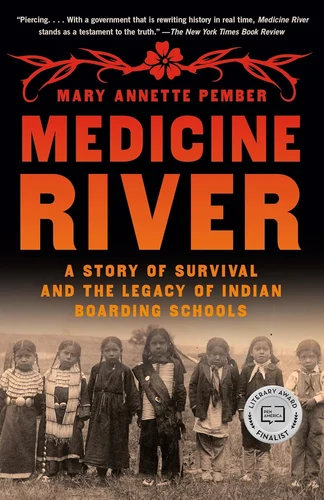
Pember is an Ojibwe journalist, and this book is not a history textbook. It is a memoir. She starts with her own mother, a woman named Geraldine. Geraldine was sent to a Catholic boarding school when she was six. She was given a new name, a new language, and a new god. She was beaten for speaking Ojibwe. She was told her family was dirty, her culture was evil, her soul was lost. Pember does not describe these scenes with fury. She describes them with a kind of quiet, clinical precision that is somehow more devastating. You watch Geraldine grow up, marry, have children. You watch her become a woman who could not hug her kids, who could not say “I love you,” who kept everything inside. The core conflict is not between Pember and the government. It is between Pember and her mother’s silence. How do you love someone who cannot let you in? The suspense here is not about what happens next. It is about whether love can survive what was broken so long ago. I will not tell you the ending. But I will say this: the book made me call my mother again the next day.
The Knife and the River
The central theme of Medicine River is inheritance. Not of land or money, but of trauma. Pember shows us that the violence of the boarding schools did not stop when the children came home. It changed shape. It became alcoholism. It became depression. It became the inability to touch your own child. The key imagery in the book is the river itself. Medicine River is a real place in Wisconsin, a waterway that runs through Ojibwe land. Pember uses it as a metaphor for memory. The river flows, but it also carries things underneath. You can see the surface, but you cannot see the debris that sank decades ago. She writes about her own journey to find the river, to stand in it, to let the cold water run over her feet. It is a small moment, but it is the heart of the book. She is not trying to fix the past. She is trying to stand in it, to feel its weight. The author’s craft is humble. She does not lecture. She lets her mother’s story speak for itself. And in doing so, she reveals a universal pattern. Every family has a river. Every family has a silence that runs deeper than words. Her struggle becomes our struggle, if we are honest enough to look.
What We Do With the Silence
I finished Medicine River on a Tuesday night. I sat on my couch and did not move for a long time. The book does not offer easy answers. Pember does not claim to have healed her mother. She does not claim that writing this book fixed anything. What she does is something more difficult. She stays. She stays in the mess, in the confusion, in the anger and the love that cannot be separated. The book’s cross-era resonance is startling. We live in a time where people talk about “breaking cycles” and “doing the work.” But how? This book shows that the work is ugly and slow and often invisible. It is not a TED Talk. It is a daughter sitting with her mother in a hospital room, not knowing what to say, but refusing to leave. The core insight of Medicine River is this: survival is not the same as living. The boarding school survivors survived. But many of them did not get to live. The job of the next generation is not to forgive the unforgivable. It is to learn how to live, so that the survival was not in vain. That is what Pember does. She learns to live. And she teaches us, gently, that maybe we can too.
