Some of the hardest conversations in life are not about huge problems. They might start with a forgotten message, a disagreement over money, a child refusing to cooperate, or a partner doing something that feels inconsiderate. The actual issue may be small, but once both people become defensive, the conversation can quickly become about blame, old frustrations, and who is at fault.
Marshall B. Rosenberg’s Nonviolent Communication looks at what happens underneath these kinds of exchanges. First published in the 1990s, the book presents a communication approach built around understanding observations, feelings, needs, and requests. Rather than teaching people how to win an argument, Rosenberg focuses on creating conversations in which both sides have a better chance of being heard.
That makes the book particularly useful for anyone who has ever walked away from an argument thinking, “That didn’t go the way I wanted at all.”
About Nonviolent Communication
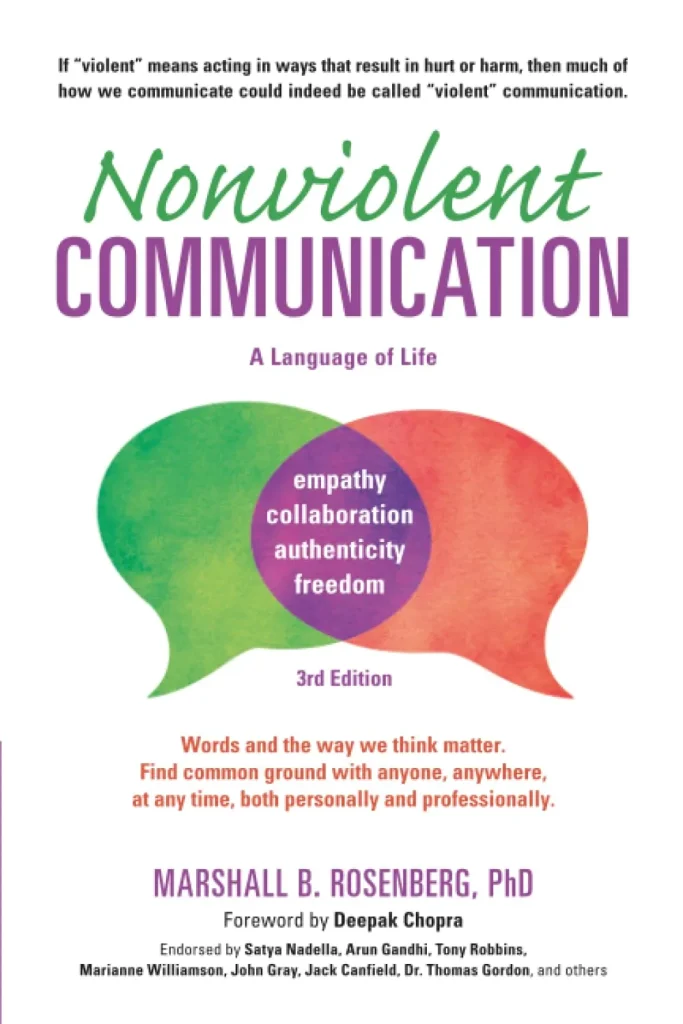
Rosenberg developed Nonviolent Communication through his work as a psychologist, mediator, and educator. His approach has been used in relationship settings, schools, workplaces, and conflict-resolution work, but the ideas are just as relevant to ordinary conversations at home.
The book is less interested in giving readers clever phrases and more interested in changing the way they understand communication. A harsh comment, for example, may not really be about the words themselves. It may come from feeling ignored, overwhelmed, insecure, or frustrated about an unmet need.
Once you start looking at conversations this way, arguments can become easier to understand. Instead of only asking who said the wrong thing, you can begin asking what each person was actually trying to communicate.
We Often Mix Facts With Judgments
One of the book’s most useful ideas is learning to separate what happened from what we think about what happened. In everyday conversations, these two things are often mixed together without us noticing.
Someone might say, “You never listen to me,” after being interrupted twice. Another person might hear that as an attack and immediately start listing all the times they did listen. The original problem gets buried because both people are now defending themselves.
Rosenberg encourages a more specific way of describing situations. Instead of turning one behavior into a statement about someone’s entire personality, it is often more productive to describe what actually happened and deal with that particular behavior.
This can sound like a small change, but it can make a conversation much less threatening. People generally have an easier time responding to a specific problem than defending themselves against a judgment about who they are.
Feelings Can Tell You More Than You Think
The book also places a lot of importance on recognizing feelings accurately. Many people are used to expressing emotions indirectly, especially when they are uncomfortable admitting that they feel hurt, anxious, disappointed, or vulnerable.
That is why statements such as “You make me feel ignored” can sometimes replace a more honest description of the emotion. The first version puts the other person at the center of the sentence, while the second gives you a clearer picture of what is happening inside yourself.
Learning to identify emotions can be surprisingly difficult, particularly for people who have spent years pushing uncomfortable feelings aside. But the more clearly you understand what you are feeling, the easier it becomes to figure out what is actually bothering you.
This is one of the areas where the book connects strongly with emotional regulation. Instead of reacting immediately, you have a chance to understand the emotion before deciding what to do with it.
What Is Underneath Anger?
Rosenberg’s ideas about needs are another major part of the book. Behind frustration or anger, there is often something a person cares about but has not expressed clearly.
A partner might become irritated because they feel unsupported. A parent may lose patience after asking for the same thing repeatedly because they are exhausted and need cooperation. A coworker may become resentful because they feel that the workload is unfair.
Seeing the need behind the emotion does not automatically make the behavior acceptable. Someone can still communicate badly or behave unfairly. What this perspective does is make the situation easier to understand, which can help people address the actual problem instead of arguing endlessly about the emotional reaction.
Asking for What You Need Is Harder Than It Sounds
Many communication problems come from expectations that were never clearly spoken. We assume other people should know what we want because the situation seems obvious to us.
A person may hope their partner will notice that they need help. A parent may expect a child to understand why a certain rule matters. A friend may become disappointed because they believe someone should have realized they were upset.
When those expectations remain unspoken, disappointment can quickly turn into resentment.
Nonviolent Communication encourages people to make requests more directly. That does not guarantee that the other person will agree, but at least both sides understand what is actually being asked. It is much easier to respond to a clear request than to guess what someone wants from you.
Listening Does Not Mean Agreeing
The book is equally concerned with how we listen. When someone is upset, our first instinct is often to explain, correct, defend ourselves, or prove that their interpretation is wrong.
That reaction is understandable, but it does not always help.
Rosenberg’s approach asks readers to listen for the feelings and needs underneath what another person is saying. You can understand why someone is upset without agreeing with every part of their argument, and you can acknowledge someone’s feelings without promising to give them everything they want.
That distinction is especially useful in close relationships. People often become calmer once they feel that their experience has been recognized, even when the disagreement itself has not disappeared.
Communication Gets Worse When We Are Already Overwhelmed
Good communication is easiest to talk about when everyone is calm. Real life is different. People usually struggle most when they are tired, stressed, disappointed, or already carrying frustration from previous interactions.
This is why some of the book’s ideas are more difficult to use than they first appear. It is one thing to understand the difference between a judgment and an observation while reading a book. It is another thing to remember that difference when you are angry and someone has just said something that hits a nerve.
Still, becoming aware of these patterns can make a difference over time. You may begin to notice when a conversation is shifting from the original issue into personal attacks, or when you are reacting to an emotion rather than the situation itself.
That awareness creates a little more space between the emotional reaction and the next thing you say.
The Book’s Approach to Conflict Is Different
A lot of relationship advice treats conflict as something that needs to be solved as quickly as possible. Nonviolent Communication takes a different approach by first trying to understand what each person is experiencing.
That does not mean every disagreement can be resolved peacefully or that both sides will always find a compromise. Some people will want different things, and some conflicts involve genuine incompatibility.
What changes is the quality of the conversation. Instead of spending all your energy proving that the other person is wrong, you have a better chance of identifying what matters to each side and deciding what can realistically be done.
For long-term relationships, that can be more valuable than having a perfect argument.
What Makes Nonviolent Communication Worth Reading?
The book’s biggest strength is that it gives readers a practical framework for understanding conversations that otherwise feel chaotic. It takes familiar problems such as criticism, resentment, defensiveness, and emotional outbursts and breaks them down into smaller pieces that are easier to examine.
It also works across different types of relationships. The same basic communication problems can appear between partners, parents and children, friends, or coworkers, even though the specific situations look different.
Another reason the book remains useful is that it encourages responsibility without placing all responsibility on one person. You are asked to understand your own feelings and needs, but you are also encouraged to listen seriously to what the other person may be experiencing.
Who Should Read Nonviolent Communication?
This book is a good fit for readers who want to communicate more clearly while also becoming better at handling difficult emotions. It is especially relevant for people who tend to avoid conflict, become defensive quickly, or keep their frustrations inside until they eventually come out in a much stronger way.
It may be helpful for people who often argue with a partner, struggle to express what they need, find it difficult to set boundaries, or feel that conversations repeatedly turn into misunderstandings. Parents may also find the ideas useful because children often communicate strong emotions before they have the vocabulary or maturity to explain what is actually bothering them.
The book is not a quick collection of conversation tricks, though. Its approach asks readers to change the way they think about communication, so getting the most from it requires some reflection and practice.
Final Thoughts
Nonviolent Communication is ultimately less about finding the perfect words and more about understanding what is happening underneath those words. When people are angry or hurt, they do not always say exactly what they mean. A complaint may come from feeling unappreciated, a harsh reaction may come from fear, and an argument about a small event may really be connected to a much bigger unmet need.
That is what makes Rosenberg’s approach interesting. It gives readers a way to slow down those moments, understand their own reactions more clearly, and listen to other people without immediately turning every disagreement into a personal battle.
For anyone trying to improve communication, manage emotional reactions, and build healthier relationships, Nonviolent Communication offers ideas that can be applied long after the last page is finished.