The Gull Yettin is a full-length wordless graphic novel created over three years by British cartoonist Joe Kessler. Without a single word, the book uses only woodcut-style overlays of red, blue, yellow, and green to tell the story of the strange emotional bonds between a boy, an anthropomorphic Seagull Man, and a woman. On the surface, this is a coming-of-age fable about trauma and healing, but Kessler’s ambition extends far beyond that—Yettin’s guardianship is laced with jealousy and possessiveness, while kindness and cruelty intertwine like vines, creating the work’s most poignant tension. By completely eschewing text, he compels us to become “co-creators,” piecing together meaning ourselves within the flow of images. As he stated in an interview: “Once you remove the text, everything becomes more direct and powerful; it’s as if a barrier has been lifted, making the story come alive.”
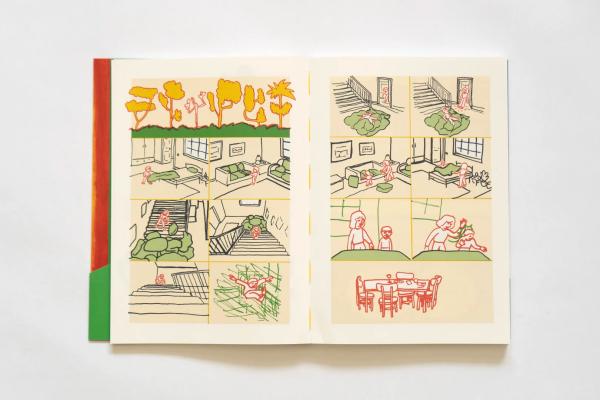
Without uttering a single word, the author constructs such a strange world. And to explore these complex emotions, he chose the boldest narrative approach—wordless comics offer a sense of freedom from the constraints of text. As his first full-length work, Kessler wanted to take his time, completing it with the patience of water wearing away stone. Readers can breeze through the 200-plus pages, as he masterfully depicts the story’s development and conflicts using four colors; all emotions pour out in a torrent of color and line, intense and lingering. The lines are bold, the emotions turbulent—did the author feel the same surging emotions while creating this as the reader does? It doesn’t really matter. The expressions and movements of Seagull Man are deeply compelling—extreme sorrow, extreme remorse, extreme pain. Simplification does not equate to weakening; rather, it amplifies the impact through imagination and reflection. The stylistic shifts in the scenes are particularly surprising—when the boy refuses to eat his vegetables, Seagull Man brings him a fish. This violent display of affection feels entirely natural coming from Seagull Man.
For readers eager to push the boundaries of their reading experience, this work is not merely a comic but an enlightenment regarding the possibilities of visual storytelling—it proves that the deepest emotions need no linguistic mediation to reach the heart directly. It portrays the protagonist’s inner loneliness, confusion, and trauma, and through Seagull Man’s presence and protection, demonstrates how companionship can heal loneliness and warmth can soothe pain.
It tells a story of warm bonds through silent images, heals loneliness through companionship, and safeguards growth with kindness. The artwork is simple and gentle, the imagery clear and straightforward. Without complex plots or intense conflicts, the overall atmosphere is quiet and tender, leaving the reader with a sense of inner peace. This is a work that conveys the principles of kindness, perseverance, and mutual redemption through a heartwarming story of small animals and humans—suitable for all ages and deeply thought-provoking.
But this book is far more than that. Its core is far more complex and profound than mere healing. It’s absolutely brilliant! The story of a mother, a monster, and a child—without a single word—is told through illustrations that perfectly capture and convey the emotions. Seagull Man didn’t want to harm the little boy at all; perhaps he was just lonely. The child’s fear made the mother afraid too, so she ended up hurting the Seagull Man. The Seagull Man was furious, yet he continued to reach out. He represents those we have othered—those cast aside and placed on a pedestal. They aren’t bad; we merely perceive them as such. In a moment of accident, he sought to take revenge on the mother but accidentally blinded her. In anguish, he transformed into a part of the tree. Afterward, he continued to help the mother, even bringing the child back to her side. In the end, because she could no longer see its strange appearance, Seagull Man became a normal little boy, staying by his mother’s side. If we simply stop viewing people through the lens of alienation, perhaps this world would be a little less lonely.
Looking back, it feels like a long dream, or a fable. There is no dialogue, only sudden disasters, irreparable mistakes, and a constant cycle of escape and redemption. Red, yellow, green, black—simple, vivid colors weave a tranquil narrative. It’s as if we’re gathered around a campfire, the flames casting light on everyone’s faces, with silent darkness in the distance, and the story flowing like music. You recall the person who bullied you in the dorm, the games you played with yourself as a child, and the small boat gliding slowly across the lake. Who is Seagull Man? Is he the figment of the tree shadows outside the window, or that pitiful creature within your heart that no one accepts? I suppose none of that matters. Before dawn breaks, there’s still a long way to go. Why not turn on the radio, look out the window, and watch the train pass quietly in the distance?
Reading has no barriers, and neither do images. The original intention behind The Gull Yettin was simply for Kessler to share a story with you in the way he found most joyful. This is a deeply sincere work, with no intention of being pretentious. Therefore, we recommend that any reader pick up this book without hesitation—no need to know the author’s background, no need to pay attention to critics or promotional blurbs, and no need to have read comics before. Treat it like a little sketch a friend drew for you, and let your curiosity guide your exploration. Everyone can decode the story in their own way and search for the clues hidden within. You may love its artistic style, or you may not fully grasp it—but if you approach it with an open mind, you will not be disappointed.
All you need to do is be a sincere observer.
It is simply a sincere sharing.
