I stood on my balcony last night, staring at a pale crescent. I’ve seen it a thousand times. But for the first time, I felt small in a good way. That’s what Rebecca Boyle’s “Our Moon” does. It takes something you take for granted and makes it feel sacred. The question at the heart of this book is simple: what would we be without the moon? Not just as a nightlight, but as a force that shaped our biology, our language, and our myths?
How the Moon Shaped Us: A Protagonist You Didn’t Know You Needed
Boyle doesn’t write about the moon like a textbook. She writes like a detective uncovering a crime scene. The moon, it turns out, is the silent accomplice to everything. She traces its birth from a violent collision, a planet-sized object slamming into Earth, and the debris that clumped together into a rock. That rock stabilized our tilt. Without it, seasons would be chaotic. Life might never have crawled out of the ocean.
But the real drama is in the details. Boyle shows how ancient creatures, from horseshoe crabs to early fish, evolved their internal clocks to match the lunar cycle. The moon pulled tides, and those tides pulled life onto land. She makes you realize that our own bodies, our sleep patterns, even our menstrual cycles, might carry the echo of that ancient rhythm.
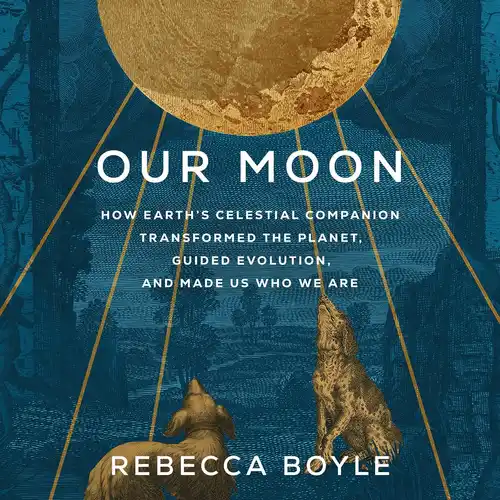
I loved the chapter on the moon in human culture. Boyle reveals how early humans used the moon to track time, to tell stories, to build the first calendars. She connects the dots between a shepherd in Mesopotamia staring at the same crescent I saw and the modern astronaut walking on its surface. The suspense is not in what happens next, but in realizing how little we know about our own history. She never reveals the final answer, because there isn’t one. The moon is still a mystery. That’s the point.
The Language of Light: How Boyle Makes Science Feel Like Poetry
The core theme here is dependence. We are not independent masters of our planet. We are a moon-made species. Boyle argues that the moon gave us the conditions for complex life, for language, for religion. She uses one powerful image repeatedly: the moon as a clock. Not just a timekeeper, but a kind of cosmic metronome that orchestrated evolution.
Her craft is subtle. She doesn’t shout. She lets the facts breathe. One example: she describes how the moon’s gravity slows Earth’s rotation. Every day is a tiny bit longer than the one before. Billions of years ago, a day was only six hours long. That short day, she suggests, might have pushed early life to evolve faster, to adapt to rapid cycles. It’s a small detail, but it reveals the whole. The moon isn’t just there. It is actively shaping us, second by second.
The imagery of light is everywhere. The moon has no light of its own. It reflects. Boyle uses that as a metaphor. We are also reflections, of our environment, of our cosmic neighbor. She shows how the moon’s phases became a template for human stories: birth, death, rebirth. The universal pattern is that we are never truly alone. The moon is a witness.
What We Gain: A Call to Look Up Again
The book’s greatest strength is its humility. Boyle admits that science still can’t explain everything about the moon. Why does its near side look so different from its far side? Why did it stop being volcanically active? She leaves those questions open. It’s refreshing. The moon is not a solved problem. It’s a living mystery.
What are its weaknesses? Honestly, some sections feel dense. Boyle sometimes gets lost in the geology of lunar rocks. I found my eyes glazing over during a long description of titanium isotopes. But that’s a minor complaint. The book is not a page-turner in the thriller sense. It’s a slow burn. You read a chapter, then you go outside and stare at the sky. That’s the reward.
This book is for anyone who has ever felt disconnected. For anyone who scrolls their phone instead of looking out the window. It’s for people who want to feel part of something larger. After reading it, I bought a small telescope. I’m not an astronomer. I just want to see the moon differently.
Read it. Then go outside tonight. Look up. Don’t just glance. Really look. You will never see it the same way again.
