Since I was fifteen, I have watched Christine Daaé fall in love with a monster. I have sung along to “The Phantom of the Opera” in my car. I have never once heard her speak for herself. That is what Erin A. Craig gives you.
I almost skipped this book. I have loved the musical for two decades, and I did not trust anyone to touch Christine’s head. Craig got the job anyway, with the blessing of Andrew Lloyd Webber’s team, and what she built is not a retelling in the usual sense. It is a restoration. The plot stays close to the 1910 Leroux novel and the stage version you already know. Christine Daaé, a young soprano at the Paris Opera House, is coached in secret by a voice she believes belongs to an angel sent by her dead father. The voice belongs to Erik, a masked composer living beneath the building, who loves her, controls her, and calls it devotion. Meanwhile Raoul, her childhood friend, offers a life above ground. Same story. Different question. So what actually changes when Christine gets to narrate her own captivity?
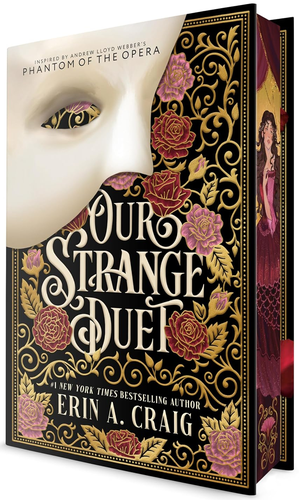
She Is Not Choosing Between Two Men. She Is Choosing Whether to Keep Her Own Voice.
Christine here is not the wide-eyed doll that stage versions sometimes flatten her into. She is ambitious, specific, and quietly stubborn about her career in a way that felt almost modern. She wants the lead role for reasons that have nothing to do with either man. That is the version of her I never got before.
Erik is written with real care and real menace. He engineers her rise, then charges her for it in obedience. There is a scene where he corrects her posture mid-lesson, gentle as a teacher, and she notices that she has stopped breathing on her own. I put the book down there. Craig shows the grooming mechanics without ever excusing them, and the scary part is how warm it all feels from inside.
Raoul is the safer pull, though not a saint. He loves her plainly. He also uses her as bait in a plan she did not consent to, and the book lets that land. Both men treat her as something to protect or possess. Neither asks what she wants. I spent 300 pages waiting for someone to ask.
That wait is the engine of the book, and it never quite resolves the way you expect.
The Mirror, the Boat, and the Music That Belongs to Her
Craig’s central image is the mirror. It appears as a dressing room door, a rehearsal reflection, a surface Erik speaks through. Christine keeps meeting herself in glass, and the book keeps asking whether the face she sees is hers or a performance for someone else’s audience. It is a restrained device and it works because Craig does not hammer it.
The candlelit boat ride to Erik’s underground lair is rendered with restraint, all damp stone and candle smoke, and the atmosphere carries genuine weight. The opera house itself functions as a second nervous system. Rehearsals, costumes, the hum before curtain. The building breathes around her.
But the strongest pattern is the music. Christine’s talent is her own. Erik merely found it first and convinced her it was a gift from beyond the grave. Every aria she sings becomes a small argument about ownership. Her voice rises. So does the question of who it belongs to.
This is where the book touched something uncomfortable in me. I once had a mentor who was generous with praise and strange about boundaries, and I remember the exact feeling of owing someone for your own growth. Craig captures that debt. It is not romantic. It is heavier than romance.
The book’s real subject is the cost of being loved by people who have already decided who you are.
Read It for Christine, Not for the Phantom
The middle sags. Some side characters, Carlotta especially, get interesting upgrades, but Meg stays thin. And the pacing assumes you already know the beats, which means readers new to the story may feel a step behind during the masked ball sequence.
The ending will divide people. I did not love it. I understood it.
This book suits anyone who has ever been the muse and wondered what the muse wanted. It also suits theater kids, obviously. Skip it if you need the Phantom framed as a romantic hero. Craig refuses. He is a brilliant, wounded, dangerous man, and she lets him be all three at once. Readers who need a clean villain or a clean love interest will leave frustrated.
What you gain is Christine. Fully. Her ambition, her grief over her father, her small daily negotiations with fear. She stops being the object the songs happen to and becomes the person the songs come from. The final pages leave her standing in her own life, choosing it, and the choice costs her something real.
The book will not settle the old argument about which man deserved her. It has no interest in that fight. It will make you hear “The Music of the Night” differently, and you will think about who taught you to want what you want.

