Everyone treats Piranesi as a puzzle to solve. It is something else. The novel’s real subject is how a mind keeps its goodness after being captured, studied, and slowly erased, and the House is not a maze to escape. It is the shape that goodness takes when everything else is taken away.
Does a person survive captivity by forgetting, or by quietly refusing to become the person their captor needs?
A Man Who Loves the Room He Cannot Leave
Piranesi narrates through journal entries, numbered by the tides. He lives in an infinite building of halls and vestibules, lined with thousands of statues, each one different. Lower floors flood. Upper halls hold clouds. He fishes, dries seaweed for fuel, measures the water, and cares for thirteen human skeletons with genuine tenderness. He believes he is happy, and honestly, he mostly is.
Twice a week a man called the Other arrives, calls him a name, and asks for help finding A Great and Secret Knowledge. The Other is impatient, condescending, and the only conversation Piranesi has. There is a prophecy about someone who will bring destruction, and the Other is very sure about who that someone is. Piranesi writes it all down without suspicion.
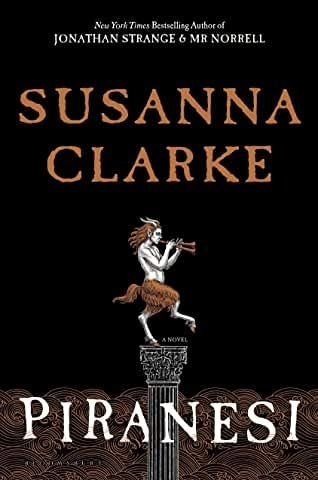
What unsettles me is how recognizable this is. Not the statues. The dynamic. Someone tells you who you are, repeatedly, with confidence and a little irritation, and eventually you write it in your journal as fact. I have done this. Maybe not with a man in a flooded hallway, but with people who were certain about me in ways that served them.
Then Piranesi finds chalk marks in a hall he has never entered, and a name that is not his, and the whole floor tilts. I will not say more. The revelation is not hard to guess, and Clarke knows that. She is not hiding a twist. She is showing you how long it takes a person to believe what is already in front of him.
Water, Statues, and the Architecture of a Captured Mind
The House is the book’s formal gene, and Clarke builds everything from it. Water rises and falls on a schedule Piranesi trusts completely. Statues stand in silent rows, some beautiful, some grotesque, most impossible to interpret. He reads them like scripture. He never asks who carved them, because the question would crack the world open.
Notice what the House does as a metaphor. It has no exit, yet it is generous. It feeds him. It shelters him. It gives him ritual, purpose, and a calendar. A prison that provides meaning is far harder to leave than one that only hurts, and Clarke makes you feel that trap from inside, in first person, with no ironic distance to protect you.
The albatross nest is the moment I stopped being a critic and became a participant. Piranesi gives away a large share of his dried seaweed, roughly three days of warmth, so two birds can raise a chick. He notes that he may be colder because of it. Then he decides that a new albatross in the World is worth the cold. That is the entire moral argument of the novel in one small decision, and Clarke never underlines it.
A mind can be robbed of its memories and its name, and still choose generosity, which means cruelty never actually owns what it steals. That is not a comfortable idea. It suggests the people who hurt us do not get to decide who we become, and I am not always sure I want to live up to that.
The imagery stays restrained, which I respect. Water, statues, tides, birds, bones. No fireworks. The writing is plain and slightly formal, almost eighteenth century in cadence, and it never begs you to admire it.
What Works, What Doesn’t, and Who Should Read It
The first thirty pages are genuinely disorienting, and I nearly put it down. Piranesi’s narration assumes you already know his world, so you spend a while lost among Vestibules and Halls with no map. The payoff is real, but the patience tax is real too.
The back third shifts into something closer to a suspense novel. It is gripping, and it is also a small letdown, because the mundane answers cannot compete with the mystery. The revelations are prosaic. They don’t ruin the world, but they do shrink it a little.
Read this if you liked Jonathan Strange and Mr Norrell and want to see Clarke do something completely different in under 250 pages, or if you have ever needed a book to be gentle with you. Skip it if you want plot momentum from page one, or if unanswered questions make you itch. Clarke leaves several threads loose on purpose.
What I gained is smaller than a lesson. I finished it in a bad week and felt slightly less alone in my own head, which is not nothing. This book won’t fix anything for you. It will sit beside you while the water goes cold, and it will remind you, quietly, that the people who tried to define you were never the ones who got to decide.
So which is it. Is the House a prison that taught a man to love it, or is it the last honest place where anyone ever bothered to be kind to him?

