Why Smart People Still Make Irrational Decisions
You walk into a store for one thing and leave with three. A label says “limited time offer,” and suddenly you want it more than you did ten seconds ago. You keep paying for a gym membership you barely use and a streaming subscription you never open, simply because you’ve already spent so much on them. These choices feel small in the moment, but they reveal something uncomfortable: your decisions are being shaped by factors you don’t even notice.
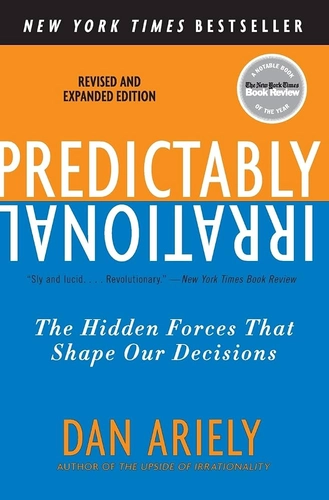
That’s the part that stings. You like to believe you weigh your options carefully, that you choose what makes sense. But the truth is, you make the same irrational moves again and again, and you rarely catch yourself doing it. In Predictably Irrational, behavioral economist Dan Ariely proves this through experiments and everyday examples. He challenges the idea that humans weigh their options logically. We believe we are choosing freely, while hidden influences decide what looks appealing, valuable, and reasonable to us.
Here’s the uncomfortable truth: smart people don’t make irrational decisions because they’re careless. They make them because their brains are designed to be influenced. And the people selling to you know exactly how that design works.
We Don’t Always Know What We Really Want
One of the book’s most interesting ideas is that our preferences are not always as fixed as we imagine. The way choices are presented can influence what we want, even when the available options have not fundamentally changed.
Think about shopping online. When a product is displayed next to a much more expensive alternative, its price may suddenly seem reasonable. Without that comparison, you might have considered it too expensive. The product itself has not changed, but the reference point has.
Ariely uses this kind of behavior to show that people often judge value comparatively rather than objectively. Understanding this tendency can help us make more deliberate choices instead of automatically following whatever looks like the best deal.
The Hidden Power of “Free”
The book also explores why people can react disproportionately to the word “free.” A free product or service may seem attractive even when it offers little real value, while a small price can make us hesitate over something we genuinely need.
This helps explain why people sign up for services they rarely use, collect unnecessary promotional items, or choose an inferior option simply because it costs nothing.
The problem is not that free offers are always bad. It is that the absence of a price can distract us from asking a more important question: would I still want this if it were not free?
Why We Keep Spending After We’ve Already Spent
Another familiar pattern is our reluctance to abandon something after investing time, money, or effort into it. You might continue watching a disappointing movie because you paid for the ticket, or stick with a purchase that no longer suits you because admitting the mistake feels uncomfortable.
This is closely related to the sunk-cost effect: past investments can influence decisions even when they cannot be recovered.
Recognizing this pattern can help in everyday life, from shopping and subscriptions to work projects and personal commitments. Instead of asking whether you have already invested too much to stop, ask whether continuing is actually worth it from this point forward.
Why Emotions Change Our Decisions
Ariely also examines how emotions can affect judgment. People may make different choices when they are angry, excited, embarrassed, or under pressure than they would make in a calm state of mind.
This matters because we often assume our decisions reflect stable preferences. In reality, the emotional state we are in can change what feels important at that moment.
The lesson is not to distrust every decision made under emotion. It is to recognize that strong feelings can narrow our perspective. For major choices, taking time to think again after the initial emotion has passed may reveal options we could not see before.
What Makes Predictably Irrational Worth Reading?
The book’s greatest strength is its use of relatable experiments and everyday examples. Rather than presenting human irrationality as an abstract theory, Ariely connects it to shopping, relationships, expectations, money, and the small decisions people make without much thought.
It is particularly useful for readers interested in understanding why people behave inconsistently, why certain marketing techniques work, and why knowing the sensible choice does not always lead us to make it.
Some of the book’s examples are tied to specific behavioral experiments, and individual findings should not be treated as universal rules for every person or situation. Its lasting value lies in encouraging readers to question their assumptions about how decisions are made.
Who Should Read It?
Predictably Irrational may appeal to readers who:
- Want to understand why people make seemingly illogical choices.
- Are interested in human psychology and behavioral economics.
- Want to recognize common decision-making biases.
- Wonder how prices, comparisons, and emotions influence behavior.
- Want to make more thoughtful financial and everyday decisions.
- Are curious about the hidden factors behind human behavior.
Final Thoughts
Predictably Irrational challenges a comfortable assumption: that we generally know why we make the choices we make. Our decisions can be shaped by comparisons, emotions, expectations, and seemingly insignificant details that escape our attention.
For readers interested in human nature, the book offers a useful way to examine both other people’s behavior and their own. The point is not to believe that everyone is irrational all the time, but to recognize that our judgment has blind spots. Once we become more aware of those influences, we have a better chance of making choices that reflect what we genuinely value.

