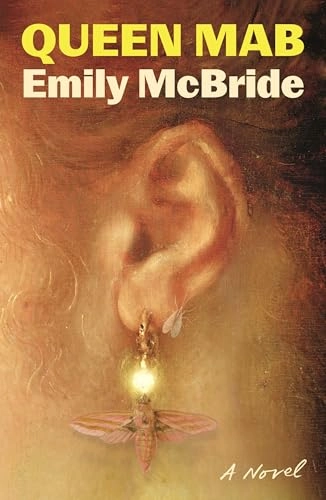
I finished this book at 2 a.m. with the baby monitor crackling static beside me. I do not have a baby. The monitor belonged to my sister, who was sleeping in the next room, and I had been reading while she rested. That is the kind of detail that matters with Emily McBride’s debut novel. Queen Mab enters your space quietly, then rearranges the furniture.
Madeleine Brodeur is twenty-three, a PhD student in Victorian literature, newly married to Tom, and unexpectedly pregnant. She is adopted. She has always been ambivalent about motherhood. None of this stops the pregnancy from happening, and none of it prepares her for what follows: a traumatic labor, an emergency C-section, and then a baby named Maud who arrives perfect and quickly becomes something else. The crying never stops. The hunger is insatiable. The eyes glint with ancient mischief. Madeleine, steeped in fairy lore from years of academic study, begins to suspect the truth. Maud is a changeling. The real baby is somewhere in the half-light, dancing with foxes and fairies. Or maybe Madeleine herself is the one who got swapped. The question drives the novel forward, and it never resolves the way you expect.
The Vocabulary Adequate to Horror
What struck me most was how McBride uses the fairy framework not as metaphor, but as diagnosis. She does not distance us from Madeleine’s psychosis. She plunges us into it. The fairy sightings are rendered with the same sensory precision as the dirty dishes and the leaking breasts and the hostile looks from other mothers at the park. That is the book’s central argument: for a woman drowning in postpartum psychosis, the language of folklore is not a retreat from reality. It is the only vocabulary adequate to the horror of what she is experiencing.
The prose shifts from first to third person as Madeleine’s grip loosens, and I barely noticed the transition until it was complete. That is deliberate craft. McBride mirrors the experience of dissociation so accurately that the reader, like Madeleine, cannot pinpoint the moment when the floor gave way. The literary references, from Brontë to Yeats to Woolf, are not decoration. They are Madeleine’s lifeline, the only coherent structure she has left. She thinks in quotations because her own voice has been drowned out by the demands of motherhood.
Here is where I must be honest about my own reaction. I read this book while my sister recovered from her own difficult birth, watching her struggle with breastfeeding and sleep deprivation and the slow erosion of her former self. I saw the exhaustion in her face. I heard the strain in her voice when she talked about feeling like a stranger in her own body. Queen Mab gave me a language for what she was going through that I had not possessed before. That is not a small thing.
The Husband Who Is Worse Than a Monster
McBride does not flinch from the uglier dimensions of this story. Tom, the husband, is not a monster. He is worse. He is a well-meaning man who goes back to work, who urges Madeleine to join mommy groups, who makes passive-aggressive comments about the cost of her eating out while she is starving from breastfeeding. He is the kind of partner who believes he is supportive while failing to see the woman in front of him at all. I wanted to throw my tablet at him, and I suspect that reaction is precisely the point. The novel indicts not cruelty, but obliviousness. Not malice, but absence.
The book also weaves in Madeleine’s father’s obsession with genealogy and DNA tests, and her grandmother’s house being cleaned out, and the family history that keeps surfacing in fragments. These threads connect to the changeling myth in ways that deepen the novel’s meditation on identity. Who are we, really? The stories we inherit, the ones we tell ourselves, the ones we are told. Madeleine’s adoption becomes another kind of changeling story. She was swapped at ten months old, placed in a family that loved her, and she has never quite known where she belongs.
The Overlapping Territories
The novel’s problems are minor but worth naming. The pacing drags slightly in the middle section, where the domestic routines become almost as repetitive for the reader as they are for Madeleine. Some readers may find the literary allusions excessive, though I found them fitting for a protagonist who has built her identity on other people’s words. The ending, which I will not spoil, may frustrate those seeking resolution. It offers something more valuable than answers. It offers the possibility that the fairy world and the real world are not opposites, but overlapping territories, and that Madeleine may find a way to live in both.
Women who have experienced postpartum depression or psychosis, and the people who love them, will find something here. Anyone who has ever felt like a stranger in their own life. Readers who appreciate literary fiction that refuses easy categorization. If you want your fairy stories light and whimsical, skip it. If you believe motherhood is a purely joyful experience and want fiction to confirm that belief, skip it. If you are uncomfortable with ambiguity and unreliable narrators, skip it.
What I took from this book is a deeper understanding of how we make sense of the senseless. Madeleine does not survive her ordeal because she finds the right medication or the right therapist or the right support system, though those things matter. She survives because she finds a story big enough to hold her experience. The fairies are not real, and they are also the truest thing in the novel. Call it madness, call it a metaphor. That does not make it untrue.
This book will not give you comfort if you are looking for a neat portrait of maternal bliss. It will not reassure you that everything works out in the end. But it will make you feel slightly less alone in the moments when you suspect that the person looking back at you in the mirror is not yourself. And in a world that tells mothers to smile and cope and never speak of the darkness, that is no small gift.
The question I kept asking myself after finishing: who is the real changeling, the mother or the child, and does the answer even matter when both have been swapped out of their own lives?

