The best personal development book for beginners is rarely the thickest one on the shelf. I learned this the hard way. Three years ago I bought a heavyweight self-help title that promised to reshape my thinking. I made it to page 40. Then it sat on my nightstand for eight months, quietly judging me every time I reached for my phone instead.
The problem wasn’t my discipline. The problem was the book. It talked about grand visions and five-year plans while I was still struggling to tell my coworker, without sounding rude, that I couldn’t take on her project. Grand ideas mean nothing when you can’t survive a Tuesday afternoon conversation.
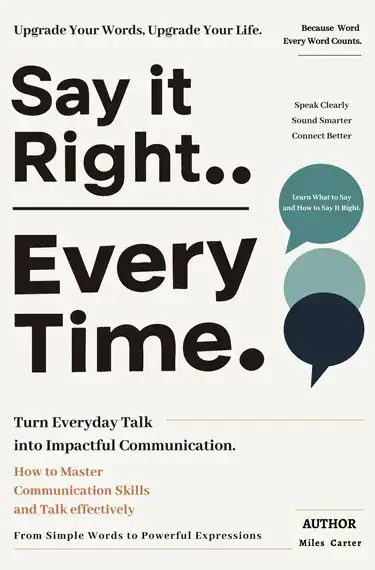
That’s why I now recommend Say It Right Every Time by Miles Carter to almost every friend who asks me where to start. It’s a practical communication guide for daily life and workplace situations. No vision boards. No morning routines. Just words, and how to use them better.

Why Personal Development Is Often a Trap for Beginners
Here’s what nobody tells you about personal development. Most beginners don’t need a new identity. They need one small win they can feel within a week.
Think about the last time you felt stuck in life. Was it really a lack of purpose? Or was it that you agreed to something you didn’t want to do, again, and spent three days resentful about it? Was it that you tried to compliment your partner and it came out sounding like criticism? Was it that you rehearsed a request in your head twenty times and still said it wrong?
These moments are small. Their weight is not.
Psychologist Albert Bandura’s work on self-efficacy, the belief that you can handle what comes at you, showed that confidence grows from mastered experiences, not from inspiration. You don’t think your way into feeling capable. You act your way there, in small, repeatable moments. And most of those moments, for most adults, are conversations.
So when a beginner asks me for the best personal development book to start with, I ask one question back: what do you actually want to get better at? Nine times out of ten, the honest answer involves other people. Saying no. Asking for something. Disagreeing without a fight. That’s not a coincidence.
Why One Sentence Can Change How People See You
Let me tell you about my friend Wei. She’s kind, competent, and chronically underestimated at work. For years she assumed it was her age or her accent. Then she read a chapter in Carter’s book about requests. She noticed her own pattern.
When Wei needed help, she said: “Sorry to bother you, I know you’re busy, but if it’s not too much trouble, could you maybe possibly look at this when you have time?”
When a colleague needed help, he said: “Can you review this by Thursday?”
Same request. Different weight. Wei’s version apologized for existing. His version assumed his need mattered. Guess whose requests got answered first?
The book is built around exactly this kind of comparison. Basic expression on one side. Mature expression on the other. You see the two versions side by side and something clicks. You’re not learning a theory. You’re recognizing yourself.
Why do people misunderstand what you really mean? Often because you soften your message until it disappears. Why is saying no so difficult? Because you were never taught a version of no that keeps the relationship intact. Carter’s answer isn’t to become colder or harder. It’s to become clearer. The book’s own promise is gentle yet firm self-expression, and that phrase has stayed with me longer than most advice I have paid for.
Where Beginners Should Actually Start
If you pick up the book, don’t read it front to back like a novel. I did that with my first attempt and retained almost nothing. Here’s what worked when I tried again.
Start with the chapter on saying no. It’s the highest-leverage skill a beginner can build. Every no you say well returns an hour of your life, and it trains the people around you to take your yes seriously.
Then move to making requests. Then conflict. Daily conversation and emotional connection can wait, because once you can hold a boundary and ask for what you need, the softer skills come almost on their own.
Each chapter includes specific case studies, so you’re never left wondering what this actually sounds like in real life. That was the part I needed most. I didn’t want principles. I wanted scripts. I wanted to know what to say when my mother-in-law rearranged my kitchen for the third time.
Here’s one small script I built from the book’s approach, for a request that feels awkward:
“I have a favor to ask, and it’s completely fine to say no. Could you watch the kids Saturday morning? I need two hours to myself.”
Notice what’s doing the work. The favor is named. The no is pre-approved. The reason is honest and short. No apology, no five-sentence buildup. My success rate with this structure is honestly a little embarrassing compared to what I used to say.
What Happens After You Finish
A book doesn’t change you. A rep does.
Pick one conversation this week that you’ve been avoiding. Write your two versions first, the one you would normally say and the one you would say if you respected yourself and the other person equally. Then say the second one. It will feel stiff. That’s fine. Stiffness fades with use.
That’s my whole case for this being the best personal development book for beginners. It starts where you actually live, in the sentences you say before lunch. Grand transformation can wait. This Tuesday cannot.
One Last Thing
I still have that heavy book on my nightstand. I keep it there on purpose. It reminds me that I didn’t need to become a different person. I needed a few better sentences, said out loud, to the people already in my life. If you’re standing at the beginning, wondering where to start, start there. Say one thing right this week. See what happens.