I was walking home from the grocery store last month when I saw her. A woman, maybe fifty, sitting on a flattened cardboard box outside the CVS. She had a small dog on her lap and a paperback book open in her hands. I walked past. Then I kept walking. That image stayed with me for days, and I think that’s why Jeff Hobbs’s new book hit me so hard. Seeking Shelter follows one mother’s journey through homelessness in Los Angeles, and it asks something I couldn’t shake:
What does it take for a person like me to stop seeing a statistic and start seeing a life?
The Woman Behind the Number
Her name is Evelyn. She is a mother, a grandmother, a woman who once had a job and a home and a routine. That is the first thing Hobbs does that surprised me. He refuses to let her be a symbol. She is not a case study or a cautionary tale. She is simply a person who fell through a series of cracks, each one small and ordinary, until the ground disappeared beneath her.
The book opens with Evelyn already homeless, but Hobbs pulls us backward with gentle hands. We see her as a young mother, as a woman who loved her children fiercely, as someone who made mistakes but never cruel ones. The core conflict, I realized, is not about housing policy or government failure. It is about Evelyn’s slow, grinding battle to hold onto her identity when the world keeps telling her she is invisible. She fights for her children. She fights for her dignity. She fights for the right to be seen as more than a problem to be solved.
I will not tell you how it ends. But I will say this: Hobbs builds suspense not through plot twists, but through the quiet terror of watching a good person slip through the safety net, day by day, until we have to ask ourselves why we let that happen.
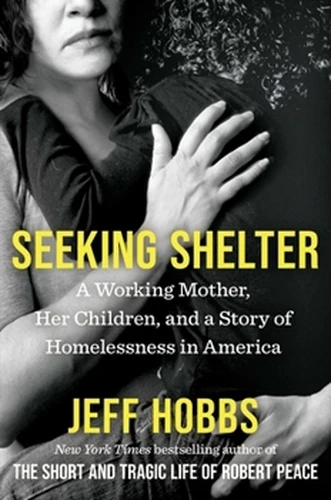
The Imagery That Stays With You
Hobbs’s central theme is visibility. Or rather, the lack of it. He shows us how homelessness is not just a housing problem. It is a relationship problem. A dignity problem. A problem of being seen by others as a person.
There is one image that I keep returning to. Evelyn describes standing outside a grocery store, watching people walk past her. She notices that they do not make eye contact. They look at their phones. They look at the sidewalk. They look anywhere but at her. Hobbs writes this moment quietly, without drama, and that restraint is what makes it devastating. He does not lecture us. He just shows us what we do.
The key metaphor here is the shelter itself. It appears and reappears throughout the book. A shelter is not a home, but it is not nothing either. It is a halfway place, a liminal space between being seen and being forgotten. Hobbs uses this image to build his argument slowly, carefully: that we have built a society where temporary solutions have become permanent, and that we have accepted this as normal.
The book quietly asks not why people become homeless, but why we stop seeing them once they do.
What I found most moving was how Hobbs connects Evelyn’s story to something larger without losing her specificity. She is not Every Homeless Person. She is Evelyn. And yet, her struggle reveals something universal about how we treat people who have lost the markers of respectability. A job. An address. A credit score. Without those, do you still count as a real person?
What This Book Taught Me
I will be honest. I finished this book feeling uncomfortable. Not because it was poorly written. It is beautifully written. But because Hobbs made me realize something about myself. I walk past people like Evelyn all the time. I tell myself there is nothing I can do. I tell myself the problem is too big, too systemic, beyond my reach.
Seeking Shelter does not give me easy answers. It does not offer a five-step plan to end homelessness. It offers something harder. It offers Evelyn’s face, her voice, her story. And it asks me to hold that story in my mind, even when it is uncomfortable.
Hobbs writes with the same patient, respectful attention he brought to The Short and Tragic Life of Robert Peace. He does not romanticize Evelyn. He does not simplify her. He lets her be messy, contradictory, sometimes frustrating. She has made bad choices. She has hurt people. She is not a saint. She is a person.
The book’s greatest strength, I think, is that it never pretends to have all the answers. It ends not with a solution, but with a question. And that question is the same one I have been carrying since I saw that woman outside the CVS:
What does it mean to truly see someone?
I recommend this book to anyone who has ever felt helpless about a big social problem. To anyone who has ever walked past someone on the street and looked away. To anyone who wants to understand, not just with their head but with their heart.
Maybe that is what empathy really is. Not solving a problem. Just staying present with it.
