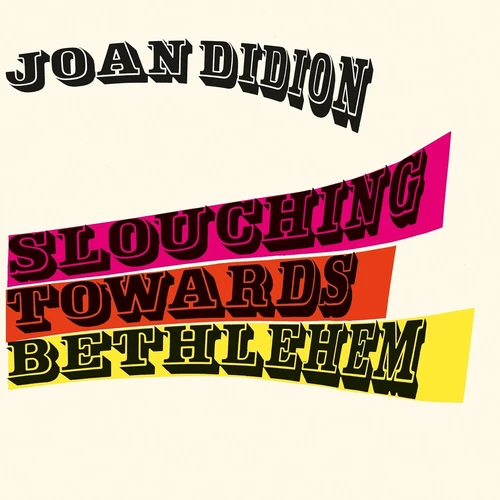
I was standing in my kitchen last week, staring at the news on my phone, when a familiar dread settled in. The world felt unhinged. Not dramatic, exactly. More like a low hum of things coming loose. I found myself reaching for a book I had avoided for years: Joan Didion’s “Slouching Towards Bethlehem.”
Why did I avoid it? Maybe I was scared. Scared that her vision of a splintering 1960s California would feel too close to home. Scared that she would name something I already sensed but could not articulate. She does. The question at the heart of this collection is not about hippies or Haight-Ashbury. It is this: What happens when a society stops believing in its own promises? And what does that do to the people inside it?
The Strange, Searching Protagonist
Didion does not write about herself. She writes through herself. The protagonist of every essay is a woman who is observant, brittle, and deeply uncertain. She goes to a remote desert town to report on a murdered woman. She attends a party for the rich and famous. She watches a five-year-old child on acid in a filthy apartment. But the story is never just the event. The story is her trying to make sense of a world that refuses to cohere.
Her voice is the hook. She writes with a kind of surgical coolness. But you feel the heat underneath. “We tell ourselves stories in order to live,” she writes in “The White Album.” That line is famous for a reason. It reveals her core conflict: we desperately need meaning, but the world keeps handing us chaos. I found myself holding my breath during the essay “Some Dreamers of the Golden Dream.” A woman dreams of a perfect life in California. That dream becomes a prison. Then a crime scene.
Didion’s greatest trick is making you feel complicit. You are not reading about a stranger’s unraveling. You are watching your own desire for order bump against reality. That collision is where the suspense lives. I will not spoil the endings. But I will say this: she never resolves things neatly. She leaves you in the middle of the mess.
The Craft of Decay
The core theme is dislocation. Not just physical dislocation, though people move around a lot. Emotional dislocation. The feeling of living in a place that was supposed to be paradise but feels more like a waiting room.
Didion’s imagery is her weapon. She uses light not as warmth but as exposure. In “Slouching Towards Bethlehem,” the California sun is harsh, relentless, revealing. It does not comfort. It bleaches everything until it looks empty. She describes a child’s face as “a picture of something already gone.” That image stayed with me for days. It captures the book’s argument: the sixties were not a revolution. They were a slow collapse dressed in flowers.
She looks at the small things. A used teacup. A worn-out shoe. A specific kind of silence in a room. Through these details, she builds a case that the center is not holding. Her craft is unsentimental. She does not mourn. She observes. And that observation becomes a form of grief. I realized, reading her, that I had been doing the same thing in my own life. Looking for signs. Trying to read the weather of a society that felt like it was changing too fast.
What This Book Means Now
Here is the uncomfortable truth. “Slouching Towards Bethlehem” is from 1968. It is about a specific time and place. But it could be about right now. Didion writes about political disillusionment, the collapse of shared values, the loneliness of people who have all the freedom in the world and nowhere to go.
Her argument is not that the sixties were bad. Her argument is that when a culture loses its narrative, people drift. They do not become evil. They become hollow. And hollow people make dangerous choices.
The book has a flaw. It is a collection, not a single argument. Some essays are weaker than others. The one about John Wayne feels dated. But the strongest essays are so sharp they leave a mark. Who is this for? Anyone who has ever felt like the world is slipping sideways and wondered if they were the only one feeling it. Anyone who is tired of cheerful optimism that does not match reality.
What will you gain? Not solutions. Didion does not offer a way out. She offers clarity. A mirror. You will finish the book and feel less alone in your unease. You will understand that some anxieties are not personal failures. They are historical weather systems passing through.
Maybe the most honest thing we can do is admit that we are all slouching. And that the first step toward standing up is seeing the fall for what it is.
