I read this book twice. The first time I kept answering the author out loud, then feeling foolish for doing it in an empty kitchen. The second time I stopped arguing and started noticing which sentences stayed with me after I closed the cover.
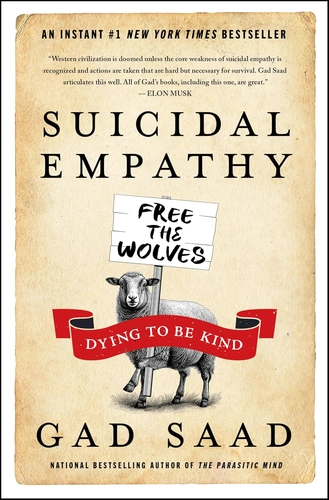
Gad Saad is a Lebanese-born behavioral scientist who fled a country that came apart, and he writes like someone who has watched the lights go out once already. His target is a habit of mind he calls suicidal empathy: compassion applied without calibration, handed over to people who mistake it for a moral shield. He argues that unchecked empathy is dismantling the West.
The question I kept circling is whether the book is diagnosing a real disease or just naming a mood.

The Scorpion, the Frog, and the Pod That Dies Together
The engine of the book is anecdote after anecdote. A father houses a young migrant employee, ignores the statistical voice in his head, and his teenage daughter is assaulted. A woman in an African country is attacked and then, in Saad’s telling, reframes her own violation as a lesson about colonial guilt. These are the moments he uses to show how compassion detaches from consequence.
Some of these cases landed hard and stayed with me. Others felt selected for maximum sting, and Saad rarely pauses to ask what a less vivid example would prove. He is building a case, not weighing one. If you want the version of this argument that also shows the counterexamples, you will not find it in these pages.
What kept me reading was the voice. He is funny in a dry, exasperated way, and the humor does real work. It keeps you from feeling preached at, at least until the next chapter.
Saad borrows the shape of the old golden mean: too little empathy and you get a psychopath, too much aimed at the wrong target and you get a society that cannot say no to anything. His central image is the scorpion and the frog, the old fable where kindness carries danger across a river and pays for it.
He also leans on a whale image, of sperm whales forming a defensive ring around an injured member while whalers close in. The pod’s instinct to protect becomes the reason it dies. That image is the one I cannot shake. It is genuinely good, and it explains more than a hundred pages of policy complaint.
His chapter on children and sleepovers got under my skin. He argues that a father who assumes all men are potential predators is not paranoid but statistically awake. I found myself half agreeing and half bristling. I have a nephew I would trust with my life, and Saad’s framework has no clean slot for him. That gap is worth sitting with.
The Volume Knob and the Missing Dial
The book’s real claim, the sentence I keep returning to, is that a society dies when it cares more about infinite tolerance than about its own survival. That is tight and undeniable in the abstract. The trouble is that once you accept it, everything from a school policy to a tax rate starts looking like evidence.
There is a stretch about taxes that felt like a detour into someone else’s argument. And the chapter on faith, while forceful, assumes a reader who already shares the premise. Saad writes for the converted more often than he writes for the curious, and the book is weaker for it.
Still, when he stays close to the scorpion and the frog, when he asks what your kindness is actually aimed at and who pays for it, the argument has teeth. I finished the book still unsure whether the West is dying or just tired. But I have started noticing, when I am kind, who I am being kind to and who absorbs the cost.
That is not nothing.
“The strongest warning is not a siren. It is a warm voice telling you that your caution is a flaw.”

