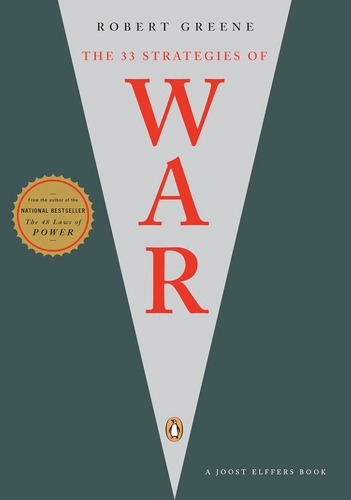
I first opened The 33 Strategies of War on a Tuesday night, feeling smug. Another Robert Greene book, I thought. Another cynical guide to crushing your enemies while sipping espresso. I had read The 48 Laws of Power years ago, dog-eared it, quoted it at parties, then quietly shelved it when I started feeling like a conspiracy theorist.
This one is different. Or maybe I am.
Three weeks later I had read it twice. The second time with a highlighter. The third time I started taking notes. And somewhere between Napoleon and the Zulu king Shaka, I realized I had been asking the wrong question about Greene’s work. The question is not whether these strategies are evil. The question is whether you can afford to ignore them.
What does it say about us that a manual for war feels like required reading for office politics?
The Pattern I Couldn’t Unsee
Let me tell you what the book does. Greene distills military history, from Hannibal to Margaret Thatcher, into thirty-three strategic principles. They range from the obvious (strike first, control the tempo) to the genuinely unsettling (the passive-aggression strategy, the death-ground strategy). Each chapter pairs a historical case study with modern applications. Business, relationships, family dynamics. The battlefield is everywhere.
And here is where my smugness died. I recognized myself in the pages. Not as a strategist. As a victim.
I thought about a colleague who always volunteered to help me, then never delivered. I thought about the manager who praised my work publicly while quietly undermining my projects. I thought about the friend who offered sympathy but somehow always left me feeling smaller. Greene names these patterns. He gives them histories. He shows how the same moves played out in Napoleon’s court, in the wars of Genghis Khan, in the boardrooms of Hollywood.
The uncomfortable truth is that this book is less a guide to becoming Machiavellian than a mirror showing you the people who already are.
The Mirror That Shows You Your Neighbors
The subtitle of my review would be “a book about war that is really about waking up.” Because once you see the strategies, you cannot unsee them. You notice the colleague who creates false urgency to keep you off balance. You notice the relative who weaponizes guilt with surgical precision. You notice the group that rewards conformity and punishes independent thought, all while preaching innovation.
Is Greene recommending we all become manipulators? No. And this is the nuance that critics miss. He is describing human nature with the detachment of a biologist cataloging species. The strategies exist whether you read the book or not. The only choice is whether you will be the one wielding them or the one being wielded.
The book is not without flaws. It is dense, over 500 pages of small print. Some chapters feel repetitive, and a few strategies blur into each other. The historical examples, while fascinating, sometimes stretch to fit the modern applications. And honestly, there were moments I had to put it down. Not because it was boring, but because I kept thinking about specific people in my life who use these tactics daily.
That is the real discomfort of this book. It does not show you monsters. It shows you your neighbors.
What Awareness Actually Costs
Anyone in a competitive field—which is to say everyone—will find something here. Anyone who has ever been blindsided by office politics, betrayed by a trusted ally, or outmaneuvered by someone less talented but more strategic. It is particularly valuable for people who consider themselves “above” gamesmanship, because those are exactly the people who get played.
If you believe that ignorance is bliss and that seeing the mechanics of manipulation will ruin your relationships, skip it. If you are going through a period of genuine emotional vulnerability, wait. This book requires a certain detachment, a willingness to look at human behavior clinically. It is a tool for the stable, not a crutch for the wounded.
What did I take from it? The self-directed warfare section alone was worth the price. Greene argues that our greatest enemy is often our own emotional reactivity, our need for validation, our inability to tolerate ambiguity. He quotes Carl von Clausewitz on the importance of calm in the face of chaos. He shows how the greatest generals mastered their own minds before attempting to master others.
I have started applying one small principle from the book: do not respond to attacks in real time. The counterintuitive strategy of non-engagement. When someone provokes me, I try to pause. I remember that the provocation is often the strategy. The goal is to make me emotional, to make me act rashly. The victory belongs to the one who stays calm.
It sounds simple. It is not.
The Mines I Now Know Where to Find
The book ends with a quote about the value of nuance and ambiguity in our judgments of people and events. Greene argues that we reduce people to simple categories—good or bad, friend or enemy—and this oversimplification causes endless problems. The wise strategist tolerates complexity. The wise strategist sees that people are a mix of qualities, that even allies can harm us, that even enemies can teach us.
Nothing in life is ever so simple.
This book will not make you a better person. It might make you a more aware one. And in a world where the battlefields are invisible, where the wars are fought with passive-aggressive emails and whispered conversations, awareness is the only armor that works. I will keep this book on my shelf, not as a weapon, but as a warning. The war is always happening. You can bury your head in the sand, or you can learn the terrain.
I chose to learn the terrain. I still do not like it. But at least now I know where the mines are.

