I read most of this book on a bench outside a grocery store, waiting for my husband to finish an errand that took forty minutes longer than promised. My phone was at nine percent. I remember that detail because John Green would have noticed it too, and probably rated it. Two stars for battery anxiety. Five stars for the light through the parking lot trees.
That’s the trick of this book. It gets into your head until you start grading your own life.
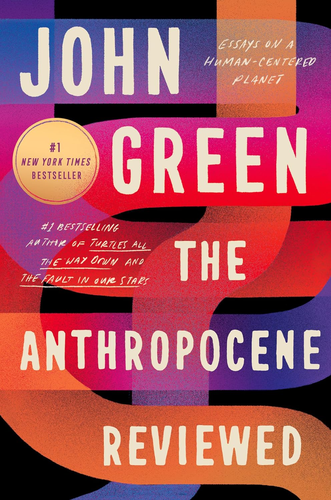
The Anthropocene Reviewed collects essays adapted from Green’s podcast. Each one examines some facet of human existence, from the QWERTY keyboard to Halley’s Comet to the Penguins of Madagascar, and grades it on a five-star scale. The premise sounds like a gimmick. It isn’t.

Green wrote most of these pieces during the pandemic, and that context seeps into every page. He was also wrestling with severe depression and OCD at the time. The book never announces this as its subject. It just lets the weight settle in.
Here’s what struck me most. The five-star scale is a system built for algorithms, as Green points out early on. Data aggregation. Machines don’t need nuance. They need numbers. So what happens when a human tries to squeeze grief, wonder, and a viral infection into that same framework?
The answer is this book.
A Man Reviewing the World While Falling Apart
Green isn’t a detached critic. He’s a middle-aged man in Indianapolis who loves his wife and kids, quotes poetry too much, and once signed over four hundred thousand sheets of paper to insert into copies of his own novel because his OCD demanded it. The man who spent his pandemic obsessively reviewing the world is also a man who needed structure to keep from drowning.
The most revealing essay is about his OCD itself. He describes the signing ritual and the way his brain treated each unsigned page as a catastrophe. Then he connects it to Hiroyuki Doi’s circle drawings, which Doi began after his brother’s death. Doi drew thousands of tiny circles, day after day. The repetition wasn’t madness. It was survival.
That essay made me put the book down for a minute. I thought about my own routines, the small rituals I perform when everything feels like too much. Green doesn’t pathologize these habits. He doesn’t romanticize them either. He just shows you what they look like from the inside.
The book’s central conflict isn’t between Green and the world. It’s between Green and the impulse to reduce everything to a rating. He wants to judge. He also wants to stay open to being surprised. Those two desires pull against each other in nearly every essay.
I won’t tell you how he resolves it. I’m not sure he does.
Five Stars for Sunsets, One Star for Staph
The core theme here is attention. Green argues, implicitly, that the Anthropocene is defined not just by what humans have done to the planet but by how we’ve learned to look at it. We rate things now. We quantify experiences. We review restaurants and benches and the spot where a movie scene was filmed.
Green’s essays resist this even as they participate in it. He gives sunsets five stars, then admits the rating is meaningless. He gives Staphylococcus aureus one star, acknowledging the bacterium doesn’t want to harm anyone. It just wants to exist.
That’s the contradiction the book lives in. We judge everything. We know our judgments are arbitrary. We keep judging anyway.
The imagery that stays with me is the Kauaʻi ʻōʻō, a bird that went extinct decades ago. The last recording of its call, a mating song that will never receive an answer, plays during one of the essays. Green doesn’t overplay the moment. He just lets the silence around that call do the work.
I think about that bird more than I expected to. A creature singing into a forest that no longer contains anyone who can hear it. That’s the Anthropocene in one image. We are surrounded by endings we caused and can’t undo.
Green’s gift is making you feel those endings without letting you drown in them.
Companionship, Not a Cure
This is where I have to be honest. The Anthropocene Reviewed will not fix your anxiety about the planet. It won’t give you a plan for climate action. It won’t make you feel better about the future in any concrete way.
What it will do is sit with you while you feel bad. That’s not nothing.
The book has problems. Green’s voice can grate if you’re not in the mood for it. He quotes other writers constantly, sometimes to the point where his own thoughts feel buried under theirs. He acknowledges this in the postscript, wondering if he’s too full of quotes. I think he is. But the quotes are good ones, and his willingness to admit the excess feels like a kind of grace.
Some readers will find the essays too short. Others will find the personal material too heavy relative to the historical content. I found the balance mostly right, though the pandemic sections hit harder now than they might have in 2021.
Who should read this? Anyone who has ever felt exhausted by the world and still wanted to find something worth paying attention to. Anyone who likes essays that wander but eventually arrive somewhere. Anyone who has rated something five stars and immediately wondered what that even means.
Who should skip it? Readers who want straight science writing. People who find Green’s sincerity uncomfortable. Anyone looking for a book that offers solutions rather than companionship.
What I took away was smaller than a lesson. It was more like a posture. A way of standing in relation to the world that doesn’t require me to decide whether it deserves praise or blame. Green calls this hope, and he insists it’s not sentimental. I believe him.
The book ends with a series of essays about his own life. His kids growing up. His marriage. His mental illness. The ratings become less frequent. The judgments matter less. What remains is the act of paying attention, which Green suggests is the only response that makes sense in an age we can’t escape and didn’t choose.
I finished the book and wanted to call my brother. I didn’t have anything to say. I just wanted to hear his voice.
Maybe that’s what five stars means. Not perfection. Just the recognition that something was worth the time you gave it.
“The only thing we can do is pay attention. And I do believe that attention is the rarest and purest form of generosity.”

