I met this book on a Tuesday night, after putting my own phone face-down on the nightstand. It sat there, glowing faintly, and I could feel it pulling at me. I picked up Haidt’s book instead. Three pages in, I had to put it down. The data hit like cold water, and I realized I was reading about my own parenting, my own distractedness, my own quiet relief that the iPad could buy me thirty minutes of silence.
The Anxious Generation makes one central argument: we have overprotected children in the real world while leaving them utterly unprotected online, and this double failure has rewired childhood itself. The play-based childhood, where kids roamed, scraped knees, and solved their own problems, died somewhere in the 1980s. The phone-based childhood replaced it around 2010. Haidt asks a simple, devastating question: what have we done to our children?
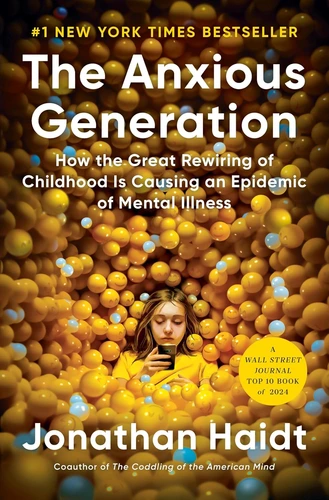
The Great Rewiring
Haidt’s protagonist is not a single person. It is an entire generation, Gen Z, the first to grow up entirely inside the smartphone era. Their mental health collapsed in the early 2010s, with depression, anxiety, and self-harm more than doubling on many measures. The book traces this collapse with remarkable clarity, showing how sleep deprivation, attention fragmentation, social comparison, and loneliness compound each other. Girls suffer more from social media’s beauty standards and social contagion. Boys retreat into gaming and pornography, withdrawing from the real world almost entirely. Neither path leads anywhere good.
What struck me most was Haidt’s account of the “Great Rewiring” as a mass experiment nobody consented to. Tech companies built addictive algorithms that prey on adolescent brains at the exact moment those brains are most plastic and most vulnerable. Parents, terrified of stranger danger, stopped letting kids walk to the park alone but handed them devices that opened doors to predators, bullies, and infinite comparison. The mismatch is almost absurd. We locked the doors and left the windows wide open.
The core imagery of this book is the contrast between two kinds of childhood. I kept returning to Haidt’s description of risky play, the kind of unsupervised exploration that teaches kids to manage fear, assess danger, and recover from failure. My own childhood had that. I remember falling out of a tree at nine, walking home with a bleeding elbow, and feeling oddly proud. No adult saw it. I handled it myself. That experience, small as it was, built something in me. Kids today don’t get those moments. They get curated feeds and parental surveillance instead. Haidt argues, convincingly, that this trade is catastrophic.
What We Owe Our Kids
There is something uncomfortable about reading this book as a parent. Haidt is not gentle. He names our collective cowardice, our willingness to trade our children’s development for convenience. The science is clear, the correlations are strong, and the mechanisms are plausible. He is honest about the limits of the evidence. Meta-analyses disagree, and critics point out that correlation is not causation. But Haidt’s response is compelling: if a million kids are drowning in a pool, you do not need a randomized controlled trial to start throwing life preservers.
The book’s strength is its practical framework. Haidt proposes four rules: no smartphones before high school, no social media before sixteen, phone-free schools, and far more unsupervised play. These are not radical ideas. They are common sense, backed by data. Australia has already banned social media for under-16s, and three-quarters of the population supports it. Change is possible. The book’s weakness, perhaps, is its optimism. Haidt believes society can coordinate to fix this. I want to believe him. I am not sure I do.
Parents, grandparents, teachers, school administrators—anyone who has ever handed a crying toddler a screen to calm them down should read this. People fully comfortable with the status quo, who see nothing wrong with a twelve-year-old spending six hours a day on TikTok, should skip it. If you are looking for reassurance that everything is fine, this book will not give it to you.
This book will not guilt you into throwing your phone in the ocean. It will not make you a perfect parent. But it will make you look at your child’s screen time differently, and it will make you feel slightly less alone in your unease. That is no small thing. The question Haidt leaves us with is not whether we understand the problem, but whether we have the courage to act before another generation is lost.
