I grew up in a small town where everyone knew the story of the old house at the end of Maple Street. It had burned down in the 1970s, but nobody ever built anything new there. The ground stayed empty. When I asked my grandmother why, she just said, “Some things don’t need to be rebuilt.” I never understood what she meant until I read Wright Thompson’s The Barn: The Secret History of a Murder in Mississippi.
The book is not about a building, exactly. It is about what a building can hold. Thompson focuses on a single structure in the Mississippi Delta, a barn where 14-year-old Emmett Till was murdered in 1955. That murder became a spark for the Civil Rights Movement, but the barn itself remained standing for decades, a silent witness. Why did no one tear it down? Why did no one talk about it? That question—what does a place do with a secret?—is the one Thompson sets out to answer, and it is the same question that haunts every small town, every family, every country that has ever looked away.
The People Who Stayed Inside the Silence
Thompson introduces us to the people who lived in and around that barn, and to the ones who came after. He shows us not just the killers, but the people who knew and said nothing. There is a white farmer named J.W. Milam, one of the men who murdered Till. There is his wife, Carolyn Bryant, whose lie about Till started everything. But Thompson does something I did not expect. He lingers on the people who were not the monsters. The neighbors. The lawyers. The journalists who came and went. The ones who stayed.
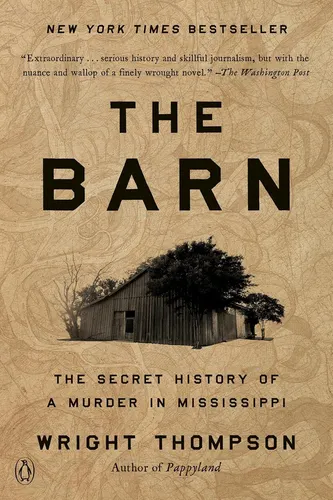
I found myself thinking about the people who lived in that barn’s shadow for generations. They walked past it every day. They saw it rot. They knew. And they did not speak. Thompson does not judge them. He just shows you their faces, their lives, their small decisions. It is a quiet, almost unbearable portrait of complicity. You start to wonder: What would I have done? What do I do now, in my own life, when I see something I should not ignore? The book does not let you off the hook. It does not let me off the hook. It makes you sit in that uncomfortable silence until you cannot stand it anymore.
The Weight of a Place, the Pattern of a Nation
The core theme of The Barn is not just racism. It is the way a society learns to live with its own violence. Thompson uses the barn as a metaphor for America itself. A place that saw something terrible, and instead of being torn down or rebuilt, just stayed. It became a kind of scar tissue on the landscape.
Thompson’s imagery is spare and devastating. He describes the barn’s wood, the way the Mississippi sun beat down on it, the dust. He does not need to say much. The place itself does the work. I remember a passage where he describes the barn’s roof finally caving in, decades after the murder. It felt like the country finally exhaling. But then he reminds you: the barn is gone, but the ground is still there. The soil is still red. The story is still alive.
This is the universal pattern Thompson uncovers. Every place has a barn. Every family has a room no one enters. Every country has a history it would rather forget. But the book argues that forgetting is not freedom. It is just a longer kind of pain. I realized, reading this, that my grandmother’s empty lot was not empty at all. It was full of something I had never learned to name.
What We Learn When We Finally Listen
The Barn resonates across eras because it is not just a history of a single murder. It is a book about the present moment. About the way we still look away from uncomfortable truths. About the way we let old buildings stand and old silences grow.
Thompson’s book has one small weakness, I think. It can feel too patient. He takes his time, and sometimes you want to shout at the page: Just say it, just name the thing. But that is the point. He is not writing a thriller. He is writing a meditation on how silence works. And silence, as he shows us, is never really quiet.
So who is this book for? Anyone who has ever wondered about a place they drive past every day and never think about. Anyone who has ever felt a story in the air but could not hear it. Anyone who wants to understand how a single act of violence can ripple through decades. What you will get is not comfort, exactly. It is something harder and more valuable: the ability to hear what a place is saying, even when it is not speaking.
I recommend The Barn with the same caution I would give a friend before a difficult conversation. It will not be easy. But it will be true. And maybe that is enough.
