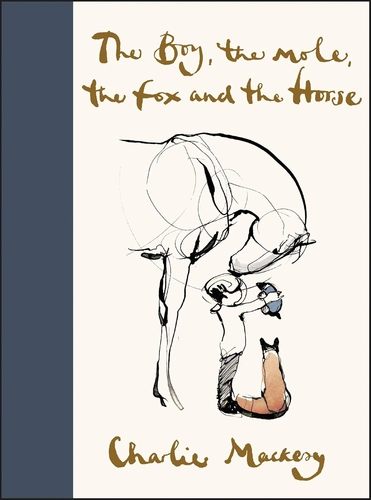
I found it on a coffee table at a friend’s house, the kind of home where guests are encouraged to linger. The cover was unassuming, a simple ink drawing. I picked it up intending to flip through for thirty seconds. Thirty minutes later, I was still there, my tea gone cold, my throat tight. I had to get a copy for myself immediately. This is a book that makes you want to hold it, to keep it close, to press it into the hands of someone you love. The question it poses is not about plot or character development. The question is simpler and more terrifying: what if being soft is actually the bravest thing you can be?
The Fox Who Understood Silence
The boy is our guide, and he is lost. That is the entire setup. He wanders through a snowy, indifferent landscape, and he is afraid. He meets the mole, who is greedy for cake and starved for connection. The mole is the talker, the philosopher, the one who fills the silence with observations. Then there is the fox, who has been hurt and has built a fortress of silence around himself. He rarely speaks. And finally, the horse, who is wise and gentle, but admits he has hidden his greatest gift—his wings—because showing them made others uncomfortable.
What struck me most was the fox. I understood him on a level that surprised me. He is the friend who sits with you at a party but never says a word, yet whose presence is the most comforting thing in the room. The narrative doesn’t force him to heal or to speak. It simply allows him to be there, to be accepted. The core conflict here is not external. It’s the internal battle each of them fights against their own self-doubt. The book asks if we can be brave enough to say “help” when we are drowning. It asks if we can be kind to ourselves when we fail. The plot is a journey, yes, but the destination is not a place. It is a state of acceptance.
The Wings We All Hide
The central theme here is not kindness, as the marketing suggests. It is the courage to be vulnerable. The imagery reinforces this with every stroke of the pen. The line work is loose, almost hesitant, like a sketch that’s afraid to commit. The ink blots and the watercolor washes are imperfect. They feel human. The horse’s wings, hidden for so long, are the book’s key image for me. They represent the parts of ourselves we suppress for the comfort of others. The horse’s struggle is universal. We all hide our wings. We dim our own light so we don’t make others feel small. Mackesy’s genius is pairing this heavy theme with the lightness of a child’s book, making the wisdom accessible without making it saccharine. He uses the mole’s love of cake to balance the profound with the silly, so we never feel lectured. He gives us space to breathe between the heavy moments.
A Quiet Courage, Not a Fix
It isn’t perfect. The handwritten font is genuinely difficult to read for older eyes, and some might find the lack of a cohesive story frustrating. It’s not a novel. It’s a collection of moments, a series of meditations. If you go in expecting a traditional narrative, you will be disappointed. This is not a book for people who want complex plots or moral ambiguity. It is a book for someone who is tired, someone who needs a reminder that they are enough. It is a book for the person who is afraid to ask for help, for the person who feels lost in the wilderness of modern life, for the person who needs to be told that they are loved. It won’t fix your problems. But it will make you feel slightly less alone in the middle of the night when the doubts creep in.
I finished it and immediately thought of a friend who was going through a divorce. I bought a second copy and mailed it to her. That is the true testament to its power. It makes you want to share it. I have read it three times since, and each time I find a new line that cuts through the noise. The book’s longevity is in its refusal to offer cheap solutions. It offers presence.
As the horse says, “Asking for help isn’t giving up. It’s refusing to give up.”
That single line has rewired my own response to struggle. It gave me permission to reach out when I would have otherwise retreated. And that, I suppose, is the entire point. It teaches us that the strongest thing we can do is let someone see our weakness.

