I counted how many times I gave advice in one meeting last week. The number embarrassed me. Someone asked a small question and I answered with a nine-minute monologue, then called it support.
Michael Bungay Stanier makes a blunt claim early on: our advice is not as good as we think it is. The rest of the book is one long attempt to prove it. I kept waiting for him to soften that claim. He does not.
So the question that stayed with me was simple. If advice is this overrated, what should replace it?
The Advice Monster and the Seven Questions
The protagonist here is not a person. It is a habit, and the book treats it like a character with a name. Bungay Stanier calls it the Advice Monster, that reflex that grabs the wheel the moment someone pauses for more than two seconds. I recognized this creature immediately. It lives in me, and it has excellent manners, which is what makes it hard to evict.
The book runs on seven questions. The Kickstart Question opens a conversation with almost no small talk. The Awe Question keeps the Advice Monster at bay and buys you time. The Focus Question asks what the real challenge is, which prevents what the author calls coaching the ghost, the habit of solving problems about people who are not in the room. The Foundation Question asks what someone wants. The Lazy Question forces a direct request instead of a rescue mission. The Strategic Question asks what you are saying no to if you say yes. The Learning Question closes the loop by asking what was most useful.
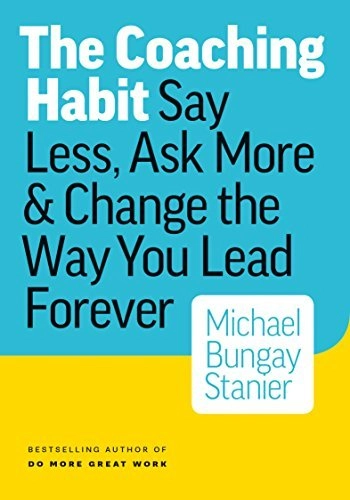
Seven questions sound thin for a whole book. What holds it together is that Bungay Stanier never pretends these are easy. He admits that staying quiet while someone struggles toward an answer feels physically uncomfortable. The suspense of the book is not whether the questions work. It is whether you can stand the silence long enough to ask them. I am still not sure I can.
Why a Small Question Carries So Much Weight
The core theme is that autonomy, not answers, is what changes people. Bungay Stanier quotes a line about asking someone a question and letting them generate the answer themselves, which increases the odds it actually sticks. That single idea does more work than any framework in the book. It reframes coaching as a transfer of ownership rather than a transfer of information.
His recurring image is the habit loop: a trigger, a routine, a reward. This is the most useful structural move in the whole book, because it admits something most leadership books dodge. Knowing the right question is worthless if your face twitches with impatience every time someone takes too long to answer it. He asks you to find your trigger, the specific moment you feel the urge to jump in, and build a new routine around it. Mine is the word “so,” as in “so what I would do is.”
The book leans hard on the three Ps, projects, people and patterns, and on a handful of psychological models, and after the third chapter the repetition starts to show. Bungay Stanier is a synthesizer more than an original thinker. He is pulling from Kahneman and Duhigg and a stack of other titles, and readers who already know that territory will find less new material than the cover promises. What he does better than almost anyone is compress. The book is short on purpose. That is a feature, though it occasionally reads like a highlight reel of better books.
A Book for People Whose Hands Itch for the Solution
Anyone who manages people, mentors students, teaches, or has ever watched a friend describe a problem and felt their hands itch for the solution should read this. I would hand it to a new manager before a performance review. I would also hand it to parents of teenagers, though I suspect that audience will resist it more.
If you want research depth, go to the primary sources. If you want a system for coaching as a formal profession, this is a starting line, not a curriculum. And if you are looking for something to admire as literature, this is not that kind of book. The prose is conversational to the point of breezy, and the self-deprecating jokes land about two thirds of the time.
What I gained is smaller and stranger than I expected. I do not remember all seven questions. I remember the Awe Question, and I have started using it in conversations where I would normally have already started talking. Sometimes it works. Sometimes I ask it and immediately answer my own question, which I assume is not the intended practice.
This book will not make you a great coach. It will make you notice, maybe a dozen times a week, the exact moment you steal a problem back from someone who was almost ready to solve it themselves. For me that noticing has been worth the price of a short, repetitive, occasionally brilliant little book. What would change in your next conversation if you let the silence run three seconds longer than is comfortable?

