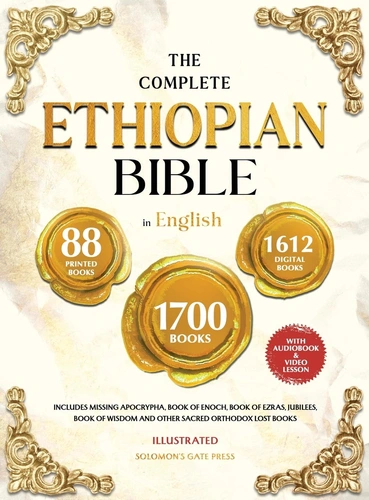
I opened the package on a Tuesday evening, kettle hissing in the background, expecting a heavy tome and maybe some scholarly footnotes. What I got instead was a theological earthquake disguised as a hardcover. The Complete Ethiopian Bible by Solomon’s Gate Press sat on my kitchen table like an accusation, 88 books thick, containing texts I had been taught to call “lost” or “apocryphal” or, worse, “non-canonical.” I grew up Protestant. My Bible had 66 books, a golden cross on the cover, and a firm belief that everything else was either fiction or heresy. So here is the question this book forced me to confront: if the Ethiopian Orthodox Tewahedo Church has preserved these texts continuously for over fifteen hundred years, who exactly lost them, and why was I never told?
Enoch’s Watchers and My Own Blind Spots
The protagonist of this story is not a person. It is the Book of Enoch itself, which opens with a vision of angels falling from heaven, their leader bound hand and foot in a valley of fire. I had read about Enoch in academic articles, always framed as “pseudepigrapha”—a fancy word for “interesting but not real.” This edition frames it differently. Here, Enoch sits between Genesis and Job, treated not as a curiosity but as scripture, with the same weight, the same sacred formatting, the same divine name Yahweh preserved in the text. I felt defensive at first. My theological training had built a wall between “canon” and “extracanonical,” and this book kicked that wall down with a single question: who decided, and on what authority?
The Ethiopian Church was never at the Council of Nicaea. It was not shaped by Roman political pressure or later European colonization. Its canon grew from a different soil, one that kept the Queen of Sheba’s visit to Solomon as foundational history and Menelik’s journey with the Ark of the Covenant as living memory. Reading Jubilees in this context, with its meticulous calendars and angelic messengers, I understood something I had missed for years. These texts were not rejected because they were false. They were rejected because they no longer fit the theological and political direction of an empire. The Dead Sea Scrolls later confirmed that Enoch and Jubilees were part of the scripture library used by Jews during Jesus’s time. The Western church simply chose not to add them back.
The Weight of Tradition and the Strain of Reading
Here is what unsettles me most. This book does not just add texts. It reframes everything I thought I knew about biblical history. The Ethiopian canon includes 1-3 Meqabyan, the Ascension of Isaiah, the Book of the Covenant, and dozens of other works I have never even heard named in a sermon. The introduction by Rev. Dr. Rance Settle guides readers through this tradition with pastoral care, but the real work happens when you sit alone with a text like the Book of Wisdom and realize it reads like Proverbs with a deeper, more philosophical edge. The problem with this edition, and it is a real problem, is the physical book itself. The font is genuinely tiny, almost unreadable for older eyes, and mine are not young. Multiple reviewers mention this, and I understand why. A 3,000-year-old tradition deserves better typography.
The digital library helps, with PDF files you can zoom and audio narration that reads in a lovely voice, plus over 150 hours of video teachings accessible through QR codes. That is a generous offering. But I kept thinking about my grandmother, who would have loved this book and could not have read a single page of it. There is something ironic about preserving ancient texts while making them physically inaccessible to the elders who most need them. I also noticed, as one reviewer pointed out, that Matthew 17:21 is missing from this edition, the verse about prayer and fasting. I do not know why that is, and the book does not explain it. That omission bothers me, not because I think the verse is essential, but because a Bible that claims completeness should account for its own editorial decisions.
What This Book Gives You
If you are a scholar, you will find a fascinating window into a Christian tradition that developed independently of Rome and Constantinople. If you are a believer, you will encounter texts that deepen your understanding of early Jewish and Christian thought. If you are a skeptic, you will at least confront the uncomfortable fact that the Bible you know is the product of specific historical choices, not divine fiat. I would not recommend this to someone looking for devotional reading before bed, because the print size will strain your eyes and the sheer weight of the volume makes it awkward to hold. But for anyone willing to ask hard questions about what scripture is and who decides, this book is essential.
The strongest cage was never iron bars—it was warm, golden affection for the familiar. This Bible does not tell you that your tradition is wrong. It simply shows you that another tradition exists, equally ancient, equally faithful, and far more complete. The Ethiopian Church never lost these books. They were copied, taught, memorized, and safeguarded in Ge’ez manuscripts without interruption for centuries. That thought keeps returning to me, like a stone in my shoe that I cannot shake out. I do not know what to do with it yet. But I am grateful this book put it there.
This edition will not settle your theology. It will make you feel slightly less certain of everything, in the best possible way.

