I was sitting in a government building last month, waiting for a routine appointment. The fluorescent lights hummed. People in suits walked past with clipboards. I looked at the ceiling tiles, the security cameras, the locked doors. And I thought: who watches the people behind these doors? I mean really watches them.
That question has been rattling around in my head ever since I finished David Talbot’s “The Devil’s Chessboard.” It is not a comfortable book. It is the kind of book that makes you look differently at the news, at history class, at the whole idea that someone is keeping things honest.
The book is built around Allen Dulles. He ran the CIA from 1953 to 1961. But Talbot argues his influence stretched decades before and after. Dulles was not just a spymaster. He was the architect of something Talbot calls “America’s secret government.” A network of intelligence officials, corporate executives, and military leaders who operated without meaningful oversight. They made decisions about war and peace. They overthrew governments. They killed people. And they answered to almost no one.
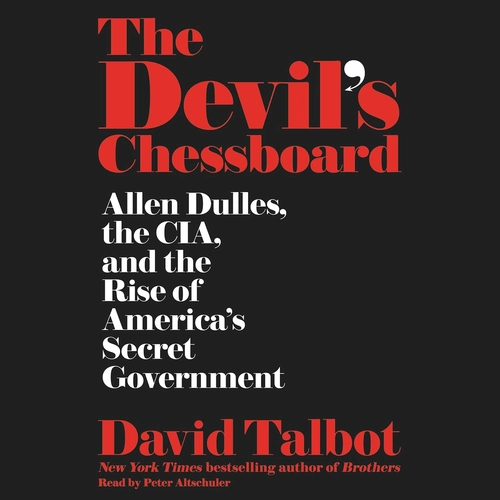
Talbot opens with a scene that sets the tone. In 1963, President Kennedy is assassinated in Dallas. Dulles is appointed to the Warren Commission investigating the murder. The same man whose agency had plotted to kill foreign leaders is now investigating the death of a president his own people despised. I read that paragraph three times. It felt less like history and more like a magician showing you how the trick works while you still cannot believe it.
The Man Who Played Both Sides
Allen Dulles is not a cartoon villain. That is what makes this book unsettling. He was a Princeton-educated lawyer from a distinguished family. His brother John Foster Dulles was Secretary of State. He spoke several languages. He had a charm that opened doors in Washington and in European capitals. He was, by all appearances, a patriot.
But Talbot draws a portrait of a man who believed the end justified almost any means. Dulles helped orchestrate the 1953 coup in Iran, overthrowing a democratically elected prime minister because he nationalized oil. He helped plan the 1954 coup in Guatemala, toppling another elected leader for the sin of land reform. He ran Operation Mockingbird, a program to plant CIA propaganda in American news outlets. He built a network of former Nazis into Cold War assets, men with blood on their hands who became valuable informants.
The core conflict in the book is not between Dulles and his enemies. It is between Dulles and the idea of democratic accountability. He did not see Congress as a partner. He saw it as an obstacle. He did not see the law as a constraint. He saw it as a suggestion. Talbot shows us a man who built systems precisely so they could not be controlled by elected officials. He created the CIA’s covert action division. He expanded the agency’s domestic surveillance. He fought against any reform that would shine light into the dark corners.
I will not spoil the ending because the story does not really end. The structures Dulles built outlasted him. They evolved. They found new leaders. Talbot suggests that the same pattern of unaccountable power continues today. The names change. The methods stay the same.
The Light That Never Reaches the Basement
Talbot uses a recurring image throughout the book. It is the chessboard. Dulles saw the world as a game of grand strategy. Nations were pieces. Leaders were pawns. You sacrificed some to protect others. The goal was not justice or democracy. The goal was control.
But the more interesting image is the one Talbot does not name directly. It is the shadow. Dulles operated in the space between what is legal and what is possible. He exploited the gap between what the public knows and what the government does. He understood that most people do not want to know how the sausage is made. They want to trust that someone is watching.
Talbot shows us the mechanics of that shadow. The secret funding. The off-the-books operations. The friendly journalists who published what the CIA wanted published. The congressmen who were told just enough to keep them quiet. It is a portrait of a system designed to evade sunlight.
There is a subtle light in the book too. It comes from the people who tried to stop Dulles. Whistleblowers. Journalists. A few brave politicians. They did not always win. Sometimes they lost badly. But Talbot records their efforts as evidence that resistance is possible. That someone was paying attention. That the machine can be seen if you look hard enough.
The book has weaknesses. Talbot sometimes reaches for connections that feel speculative. He suggests Dulles may have been involved in the JFK assassination. The evidence is circumstantial. He paints Dulles as so calculating that he almost seems superhuman. Real people are messier than this. I wanted more acknowledgment of Dulles’s own blind spots, his own fears. The man must have had them.
But the argument holds. Talbot shows how a single determined person can bend an institution. How a culture of secrecy can become permanent. How the people who are supposed to watch the watchers can be outmaneuvered by people who have been playing the game longer.
The Game We Are Still Playing
I finished this book and sat with it for a while. Then I did something I do not usually do. I looked up the current director of the CIA. I read about the agency’s budget. I searched for recent oversight hearings. I wanted to know if anything had changed.
The answer is complicated. There have been reforms. The Church Committee in the 1970s investigated CIA abuses. Congress created intelligence oversight committees. The agency cannot legally assassinate foreign leaders anymore. But Talbot’s book suggests these reforms are surface-level. The deeper problem is structural. An intelligence agency that operates in secret will always be tempted to operate without limits. The people inside it will always believe they know better than the public.
Talbot quotes a former CIA officer near the end of the book. The man says: “The agency is not a conspiracy. It is a bureaucracy. And bureaucracies do what they are designed to do.” Dulles designed the CIA to be aggressive, secretive, and unaccountable. It has been doing exactly that for seventy years.
The core insight of “The Devil’s Chessboard” is this: the people who hold power do not like to give it up. They build systems that protect themselves. They call it national security. They call it protecting freedom. But what they are really protecting is their own ability to act without consequence. The book asks us to stop trusting that someone else is watching. Because maybe no one is. Maybe there was never anyone there.
