I was at a coffee shop last week, staring at my phone. A friend had just texted: her mother’s cancer is back. Not the same spot, a new one. I didn’t know what to say. So I opened Mukherjee’s book for the third time, looking for something. Not comfort, exactly. More like understanding. The question that sits at the heart of this 600-page biography is not “How do we cure it?” but something bigger. What does it mean to live with a thing that is, in some way, part of us?
The Protagonist: Not a Person, But a Mirror
Mukherjee does something strange. He makes cancer the main character. Not a villain with a cape, but a shape-shifter. The book follows this “character” from ancient Egypt, where physicians described breast tumors as “cool, hard, and spread like a shell,” to the chemotherapy wards of 1970s Boston. But the real protagonist, I realized, is us. Our fear. Our hubris. Our desperate need to control.
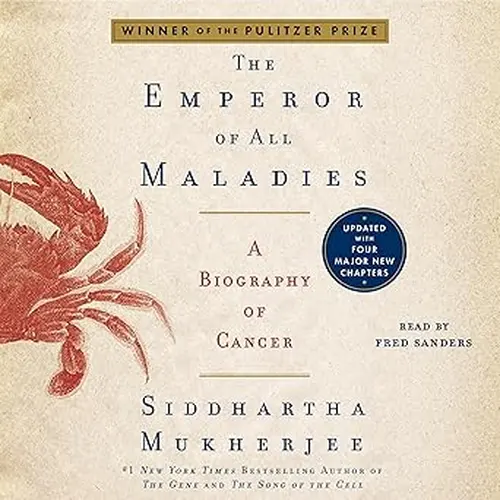
He introduces Carla Reed, a leukemia patient in her thirties, who becomes the face of modern treatment. She is a nurse, a mother, a woman who laughs even when her bones ache from the drugs. Mukherjee, her doctor, watches her body respond to a new targeted therapy. He does not pretend to be objective. He admits he feels a “terrifying tenderness” for her. The core conflict is not between doctor and disease. It is between hope and reality. One day Carla is better. The next, her cells mutate, and she is worse. Mukherjee never reveals the ending. He leaves us suspended, just as he was. This is the thing about cancer, he suggests. It does not care about your narrative arc.
A War We Cannot Win
The central metaphor of the book is war. We speak of “fighting” cancer, of “battles” and “weapons.” Mukherjee shows us how this language traps us. Early surgeons like William Halsted believed in radical removal: cut deeper, cut wider, remove the breast, the muscle, the lymph nodes. The theory was that cancer was a local invader. You could dig it out. But the imagery Mukherjee uses to describe cancer cells is different. He calls them “immortal.” He shows how they hijack our own growth mechanisms. They are not invaders from outside. They are our own cells, gone rogue.
This is the deepest layer of his argument. Cancer is not an enemy you can kill without killing yourself. Every therapy, from chemotherapy to radiation, is a poison. The trick is to poison the cancer just slightly more than you poison the patient. Mukherjee writes with a clinician’s precision but a poet’s eye. He describes a chemotherapy patient as “a body at war with itself, the cure as violent as the disease.” The book does not offer easy heroes. The scientists make mistakes. The drugs fail. The survivors feel guilt. The truth is, we are still losing this war, one battle at a time.
The Real Gift: Staying in the Dark
I will be honest. This book is not a comfort read. It will not make you feel hopeful in a simple way. What it gives you is something rarer: company. Mukherjee does not pretend to have answers. He is a doctor who has held dying hands, who has watched cells under a microscope, who has written grant proposals and failed. He admits, near the end, that “cancer is a disease of the body, but also of the mind.” The cross-era resonance is quiet but undeniable. Ancient Greek physicians called cancer a “crab” because the veins around a tumor looked like crab legs. We still use the same word. We still do not know exactly what causes it, not really.
The book is not perfect. It is dense, sometimes too detailed. The sections on chemotherapy development drag. But maybe that is the point. Healing is slow. Understanding is slower. When I put the book down, I did not feel armed for the next battle. I felt something more human. I felt like I had sat with someone who has seen the dark and is not afraid to describe it. Maybe that is what we need. Not a cure. Not yet. Just a voice that says: I see it too. I am here.
