I was talking to a friend recently. She had just lost her job after twelve years. What scared her most, she said, wasn’t the money. It was the sudden absence of that quiet belief she had carried for so long. The belief that there would always be another opportunity. Another door. Another chance to start over.
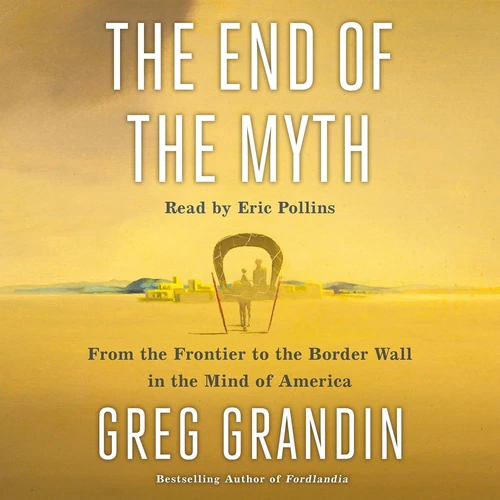
It made me think of Greg Grandin’s book. The End of the Myth is not really about borders or walls, though it covers both. It is about something deeper. It asks: What happens to a society when the thing it always relied on to solve its problems simply vanishes?
That is the question that haunts every page. And maybe you have felt it too. That quiet panic when a safety net you never even acknowledged suddenly disappears.
The Protagonist Who Never Appears
Grandin does not write about a single character. His protagonist is an idea. The frontier. That vast, imagined space that Americans believed would always be there. He traces it from Thomas Jefferson’s Louisiana Purchase to the closing of the West, then to the wars in Vietnam and Iraq, and finally to the border wall.
The core conflict is simple but devastating. For centuries, the frontier served as a pressure valve. Whenever the country faced crisis, racial violence, economic collapse, political anger, there was always a place to push that energy outward. Go west. Claim new land. Start fresh. It was a myth, yes. But it was a useful myth.
Then the myth ended. The continent filled up. There was no more west.
Grandin shows us what happened next. Instead of expanding outward, America turned inward. It began to build walls. The fear and anger that once drove expansion now drove contraction. The border wall, he argues, is not a symbol of strength. It is a symbol of something having run out.
I will be honest. Reading this, I kept thinking about my own life. The jobs I assumed would always be there. The relationships I thought were unbreakable. The cities I believed I could always return to. The frontier existed for me too, just in different forms.
The Craft of Building a Collapsing Myth
Grandin’s writing is not flashy. He is a historian, not a poet. But he has a quiet skill for making you see connections you missed before. He shows how the frontier myth was never innocent. It was built on genocide, on stolen land, on the forced removal of Native peoples. But Americans told themselves it was freedom. A new beginning.
The subtle light in this book is his treatment of time. He moves fast through centuries, but he never loses the thread. You feel the momentum. The rush of expansion. Then the sudden stop.
There is a moment in the book where he describes the 1990s. The Cold War was over. America seemed to have won. But Grandin notes that this victory felt hollow. Without an enemy, without a frontier, the country did not know what to do with itself. So it invented new enemies. It turned inward.
The image that stayed with me is simple. He writes about the endless suburban sprawl. The housing developments that pushed further and further out. It was the last gasp of the frontier impulse. A final attempt to keep moving when there was nowhere left to go.
I realized something reading this. The myth of the frontier is not just an American story. It is a human one. We all want to believe there is a place where problems do not follow us. A fresh start. But the truth is, you carry yourself everywhere.
What This Book Is Really About
Grandin makes a specific argument. He says the border wall is not about security. It is about managing despair. When the frontier no longer offered escape, the country needed someone to blame. Immigrants became the new frontier. The wall became a way to project power outward when there was no more land to conquer.
But I think there is a deeper layer here. The book is about what happens when a collective fantasy dies. And how that death can make people cruel.
I have one small criticism. Grandin sometimes rushes through periods that deserve more space. The 1960s, for example, get compressed into a few chapters. I wanted more. But maybe that is the point. The myth was always rushing forward. The book mirrors that restlessness.
So who should read this? Anyone who has ever felt the ground shift beneath their feet. Anyone who has watched a dream they counted on quietly dissolve. It is not a comfortable read. It will not give you easy answers. But it will give you language for something you might have felt but could not name.
The real emotion I am left with is something like grief. Not for the frontier. That was always a lie. But for the part of us that needs to believe in endless possibility. And the painful realization that some doors do close. Some horizons do end. Maybe that is the hardest truth of all. Not that the wall exists. But that we built it because we could not bear to admit that the dream was already over.
