I have a friend who recently stopped speaking to her mother. Not out of anger, exactly. More like exhaustion. Her mother has early-stage dementia, and every phone call feels like walking into a room where the furniture has been rearranged overnight. My friend said to me once, “I don’t know how to be close to someone who is disappearing.”
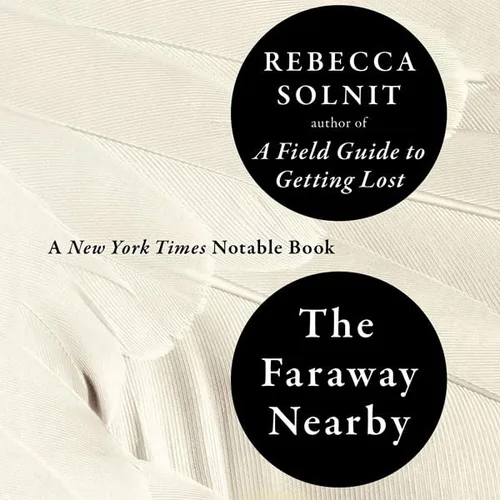
I thought of her while reading Rebecca Solnit’s “The Faraway Nearby.” The book begins with a question I didn’t expect. Solnit’s mother, diagnosed with Alzheimer’s, gives her a box of apricots. Just apricots. The fruit sits there, turning from sweet to rot, and Solnit doesn’t know what to do with them. She makes jam. She preserves the fruit, which is also a way of preserving a moment. But the mother is already forgetting. The jam is a metaphor, I guess, for something you can’t actually save.
How do you hold someone who is letting go?
The book is not really about Alzheimer’s. It is about distance. Solnit writes about her mother’s illness, but she also writes about Arctic explorers, about Mary Shelley writing “Frankenstein” in a cold room, about Che Guevara’s motorcycle journey. At first, I thought she was avoiding the hard stuff. Why talk about polar expeditions when your own mother is fading? But then I realized something. She is not avoiding. She is circling. The mother is the center, and every chapter is a ring around her.
Solnit’s mother was not easy. She was abusive, controlling, unreliable. The book does not romanticize her. It does not soften her. Solnit writes, “She had been a difficult woman her whole life, and now she was becoming a difficult ghost.” That line hit me. Because we expect grief to be clean, don’t we? We expect to mourn people we loved purely. But what if the person you’re losing was never someone you could hold in the first place?
The structure of the book mirrors this tension. Solnit jumps from story to story, from century to century, from continent to continent. It feels chaotic, almost fragmented. But that chaos is the point. When someone is slipping away, the world does not stay still. Everything becomes a search for meaning in unrelated places. You look for your mother in a book, in a photograph, in a jar of jam that has gone bad.
A pattern of holding on by letting go
There is a passage about glaciers. Solnit writes that glaciers are always moving, even when they look still. They carve valleys, reshape mountains, and leave behind debris. We see them as slow, but they are relentless. I think she is talking about memory here. About how forgetting is not a sudden collapse, but a slow grind. The mother does not vanish in one day. She leaves behind debris. A box of apricots. A half-remembered story. A feeling of being unloved.
The imagery in this book is almost too much. Solnit uses light a lot. She talks about how the Arctic summer never ends, how the sun stays up for months, how light becomes a kind of madness. And then, in the same chapter, she writes about her mother’s room, where the curtains are always drawn. The mother lives in darkness, even though the world outside is bright. This contrast stuck with me. It is not a subtle light, exactly. It is more like a light that refuses to acknowledge the dark.
Solnit’s craft here is remarkable. She takes a single image, like a bag of apricots, and spins it into a meditation on time, decay, and preservation. She does not tell you what to feel. She just shows you the apricots, and you feel it yourself.
What it means to be near the faraway
I finished this book and put it down. Then I picked it up again. I kept thinking about the title, “The Faraway Nearby.” It is a phrase that sounds like a contradiction. But Solnit argues that the things we think are far away, like our mother’s childhood or our own past, are actually right here. They are in us, shaping us, even when we do not see them.
Here is the core insight. We think of distance as a problem to be solved. We want to close the gap between ourselves and the people we love. We want them to remember us, to be present, to be near. But Solnit suggests that distance is not the enemy. It is the condition of love. You cannot hold someone without also letting them go. You cannot preserve a moment without accepting that it will rot. The jam is delicious, but it will not last.
The book is not perfect. It rambles. It is too long. Sometimes Solnit gets lost in her own cleverness. But that is also its charm. It is a book that refuses to be neat, because grief is not neat.
For my friend, I am not sure this book would help. She wants her mother back. She wants the phone calls to make sense. She wants a clean ending. But “The Faraway Nearby” offers something else. It offers a way to be with the distance. To sit inside it. To notice the apricots before they turn.
Maybe that is the real gift. Not a solution, but a permission. Permission to let the faraway stay faraway, and to find yourself near it anyway.
