I first read The Giver as a child, and I remember feeling cheated by the ending. I wanted answers. I wanted Jonas to reach Elsewhere and for everything to be okay. Re-reading it as an adult, I understand now that I was asking the wrong questions. The Giver isn’t a story about a boy escaping a bad place. It’s a mystery about what happens when a society decides that pain isn’t worth the trouble. The real question at its core isn’t “does Jonas survive?” but rather, “what are we willing to trade for a life without suffering?”
That question haunts me more now than it did when I was twelve.
The Boy Who Saw Red
Jonas is twelve years old when he’s chosen to be the Receiver of Memory. Before that, he’s just a kid who takes his pill every morning, follows the rules, and feels vaguely unsettled by things he can’t name. He sees an apple change. He hears music that isn’t there. His world is beige, literally and figuratively, and he doesn’t know it.
What strikes me about Jonas is how ordinary he is. He’s not brave or exceptional in any obvious way. He’s just the one who starts noticing. When the Giver transfers the first memory—snow and sunshine and sledding—Jonas doesn’t just learn about the past. He learns what it feels like to feel. And that’s when the horror of his community becomes unbearable.
His struggle is quiet. There are no battles, no chases. Just a boy sitting in a room with an old man, absorbing the truth of humanity, one memory at a time. The tension builds slowly, like water on stone, until the final act where Jonas makes a choice that could kill him.
I won’t tell you how it ends. The ending is the whole point of the book, not because it answers anything, but because it refuses to.
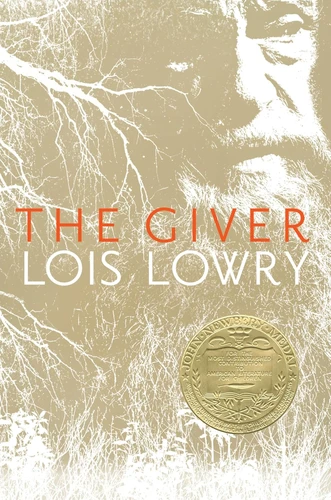
The Loneliness of Memory
The Giver‘s central argument is that memory is not a luxury. It’s a burden we must carry together. The community in the book has eliminated war, hunger, and fear. They’ve also eliminated color, music, love, and grief. They call it Sameness, and it works. No one is unhappy because no one knows what happiness is.
Lowry’s craft is deceptive. The prose is flat, almost clinical, mirroring Jonas’s world. Descriptions are sparse. Emotions are reported rather than felt. And then, when the first memory arrives, the language blooms. Suddenly there’s snow crunching under a sled, warmth spreading through cold limbs. The contrast is jarring, and that’s exactly the point. Lowry doesn’t tell us what Jonas has lost. She makes us feel it.
The moment that broke me, every single time, is when Jonas watches his father release a newborn twin. His father, a gentle man who loves his work, casually injects the baby and sends it down a chute. No malice. No hesitation. Just the terrible banality of a society that has made murder ordinary. Jonas realizes in that moment that his father has never felt love, so he can’t recognize what he’s doing.
That scene is the book’s beating heart. It shows that the strongest cage is never iron bars. It’s warm, golden affection that has been emptied of meaning.
The loneliness of holding memories is the real antagonist. The Giver carries the past alone so no one else has to. Rosemary, his previous receiver, couldn’t bear it and asked for release. Jonas understands that pain shared is pain halved, but pain hoarded becomes poison.
A Message Worth Holding Onto
The Giver has problems. The writing sometimes feels dated, and the worldbuilding leaves gaps that frustrate careful readers. The treatment of racial imagery, particularly the association of pale eyes with specialness, has aged poorly. And the sequels, while interesting, feel like they’re trying to explain a mystery that was better left open.
But this book asks questions that we’re still not comfortable answering. How much freedom are we willing to trade for safety? Is a painless life worth living if it’s also colorless? Can a society survive without its history?
I think about my own life, the days when I wish I could just stop feeling. The grief, the anxiety, the fear. There’s a part of me that envies the people in Jonas’s community. They never lie awake at night wondering if they’ve made the right choices. But they also never feel the joy of a first snowfall.
The Giver won’t give you easy answers. It won’t comfort you. But it will make you feel slightly less alone in the moments when memory feels too heavy to carry. Because it reminds you that the weight is the point. To feel everything, the pain and the joy—that’s what makes us human.
And in a world that keeps trying to numb us, that’s a message worth holding onto.
“The worst part of holding the memories is not the pain. It’s the loneliness of it. Memories need to be shared.”

