I was sitting in a coffee shop, scrolling through a medical article about the polio vaccine, when I first saw the name. HeLa cells. The article mentioned them casually, like they were just another lab tool. But something made me stop. These cells came from a woman. A real woman. And I had never once wondered who she was.
That is the question Rebecca Skloot’s book asks, quietly and then insistently. What happens to a person when their body becomes a resource? When the cells that made modern medicine possible were taken without permission, without payment, without even a thank you. Is that a theft? Or is it just progress? And who gets to decide?
The Woman Behind the Cells
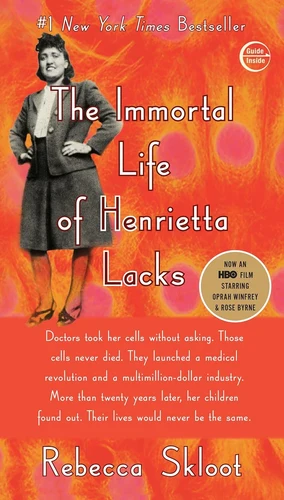
Henrietta Lacks was a black woman from Virginia. She worked in the tobacco fields. She had five children. She went to Johns Hopkins Hospital in 1951 because she felt a knot in her cervix. The doctors biopsied the tumor, and without telling her, they took a sample of healthy tissue too. That sample became the first immortal human cell line ever grown in a lab.
Skloot does something remarkable here. She does not write Henrietta as a saint or a victim. She writes her as a person. A woman who loved dancing. Who worried about her children. Who died in pain at thirty one, in a segregated ward, while her cells were already multiplying in petri dishes across the country. The portrait is tender but unsentimental. Henrietta had a temper. She kept secrets. She was, in other words, fully human.
The real tension in the book is not about Henrietta herself. It is about her family. Her daughter Deborah grows up with a mother she barely remembers, only to discover decades later that her mother’s cells are all over the news. Scientists are talking about Henrietta Lacks like they knew her. But Deborah never knew her. And she cannot understand why everyone else seems to own her mother’s story except the people who actually loved her.
What Science Owes the Dead
The core theme of this book is ownership. Not just legal ownership, though that is part of it. Skloot pushes deeper. She asks what we owe to the bodies that made our knowledge possible. Henrietta’s cells were taken in an era when informed consent did not exist, especially not for black patients. The doctors at Hopkins were not evil. They were simply operating under a set of assumptions. That poor patients, black patients, were resources to be used. That their bodies belonged to medicine more than they belonged to themselves.
There is a subtle light in this book, and it comes from Deborah Lacks. She is angry. She is confused. She is sometimes manipulated by journalists and scientists who want access to her mother’s story. But she is also curious. She wants to understand what her mother’s cells mean. She visits the lab where HeLa cells are stored. She looks at them under a microscope. She cries. And then she asks the question that haunts the entire narrative. “If my mother is so important to science, why can’t I afford health insurance?”
That moment broke me. It is not a rhetorical question. Deborah is not being dramatic. She is pointing out a wound in the world. The woman who saved millions could not save herself. And her daughter, the keeper of her memory, lives in the same poverty Henrietta knew. The cells are immortal. The family remains mortal, fragile, and forgotten.
What We Choose to See
I will be honest. I finished this book feeling unsettled. There is no neat resolution. Henrietta’s family eventually received some recognition. A foundation. A symposium. But no money. No apology that felt real. The cells are still being bought and sold. The family still struggles.
Skloot does not pretend to have answers. She writes about her own discomfort, her own role as a white journalist entering a black family’s trauma. She does not clean up the mess. She lets it sit there, messy and unresolved. That is the book’s strength. It refuses to tell you what to think. It just shows you what happened and asks you to sit with it.
Maybe that is the point. There is no clean answer to the question of who owns a body after death. There is no simple way to weigh the good of medical progress against the harm of exploitation. But there is a way to look. To not look away. To acknowledge that Henrietta Lacks was not just a source. She was a woman. And her family deserves more than a footnote.
I recommend this book to anyone who has ever taken a vaccine, received a cancer treatment, or wondered where medicine comes from. It will not make you feel good about yourself. But it might make you look differently at the world you live in. At the systems you benefit from. At the people whose bodies made those benefits possible.
