I was at a coffee shop last week, scrolling through my phone, when I saw a friend’s post about her father’s cancer diagnosis. She wrote: “He’s still going to work every day. Why?” I put my phone down. I thought of Randy Pausch. Why would a man with months to live keep teaching? Why would he give a lecture called “Really Achieving Your Childhood Dreams”? What is he trying to tell us, honestly, that we keep missing?
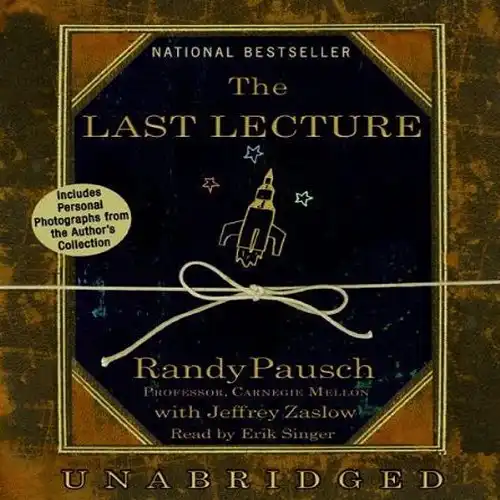
Character and Plot: A Professor Who Refuses to Say Goodbye
Randy Pausch is not a hero in the Hollywood sense. He is a computer science professor at Carnegie Mellon, a husband, a father of three young kids. He has pancreatic cancer. The doctors give him a few months. Most of us would imagine he spends those months making peace, writing letters, saying goodbye. He does some of that. But the core of “The Last Lecture” is something else. He goes to work. He delivers a lecture that becomes a book.
The book does not follow a traditional plot. It is a collection of stories from his life. Growing up wanting to be an astronaut, or to work for Disney, or to play in the NFL. He tells us about the football coach who criticized him harshly. He tells us about the rejection letters from Disney. He tells us how he built a virtual reality world. Each story answers a question: What did you learn when you hit the wall?
And the walls are everywhere. His childhood dreams sometimes seemed impossible. He was not the tallest or the strongest. He did not have connections. But he never frames these obstacles as tragedies. He frames them as tests. The wall is not there to stop you. It is there to let you prove how much you want it. That line, I admit, made me stop reading for a minute. It felt like a challenge.
What Pausch does not do is pretend everything is fine. He is honest about the fear, the sadness, the unfairness. But he refuses to let the ending define the whole story. He keeps his focus on the middle, on the living. The core conflict is not between him and the cancer. It is between him and the temptation to give up, to say it does not matter anymore. He wins that fight, again and again, by showing up.
Theme and Imagery: Walls and Brick Walls
The central theme of the book is simple: you do not need to be lucky to have a good life. You need to be persistent. But persistence, for Pausch, is not about gritting your teeth and suffering. It is about paying attention. It is about noticing the small things you can control.
There is a key image in the book that stays with me. It is the brick wall. He returns to it several times. Brick walls, he says, are a feature, not a bug. They exist to filter out the people who do not want it badly enough. It sounds a little harsh, I know. But think about it. If you really want something, do you stop at the first wall? No. You find a way around it, over it, or through it. Pausch is saying that the wall is not your enemy. It is your teacher.
He also talks about “head fakes.” When he taught his students to build virtual reality, he was not just teaching them technology. He was teaching them to work in teams, to solve problems, to manage failure. The book itself is a head fake. It looks like a memoir about dying. It is actually a manual for living. He uses his own death as a backdrop to make you think about what you are doing right now, today, with your own limited time.
The imagery is not poetic. It is practical. He compares life to a game of poker. You cannot control the cards you are dealt. But you can control how you play them. There is no purple prose here. No long descriptions of sunsets. Just a man who knows he is running out of time, telling you the things he wishes he had known earlier.
Elevation and Recommendation: What You Actually Get from This Book
Crossing the years since 2008, “The Last Lecture” still works. Not because of the cancer story, but because of the everyday wisdom. Pausch talks about giving your parents a good report card as a child. He talks about apologizing properly. He talks about the value of being a “Tigger” instead of an “Eeyore.” These are not big ideas. They are small, almost obvious. And that is the point.
The book is suited for anyone who feels stuck. Stuck in a job, stuck in a relationship, stuck in the feeling that life is passing them by. It is also for people who think they need to wait for the perfect moment to start living. Pausch’s message is that the perfect moment does not exist. The only moment you have is the one you are in.
There is a limitation, though. The book is very American in its optimism. It assumes that if you try hard enough, you can overcome anything. That is not always true. Some walls are too high. Some people do not have the resources or the luck. Pausch acknowledges this briefly, but he does not dwell on it. If you are looking for a book that acknowledges systemic injustice, this is not it.
But what you do get is a permission slip. Permission to stop waiting. Permission to fail. Permission to care deeply about things that matter to you, even if they seem childish. Pausch’s childhood dream of being an astronaut never came true. But he flew in zero gravity. He worked on a Disney ride. He learned to love the process more than the outcome.
I will be honest. I did not finish this book in one sitting. I put it down a few times. It made me uncomfortable. But that discomfort is exactly what I needed. It reminded me that I am not running out of time yet. But I am also not using the time I have.
The recommendation is simple. If you have ever felt like your life is on hold, waiting for something to happen, read this book. If you have ever looked at a wall and felt defeated, read this book. It will not give you a map. It will give you a mirror. And maybe, just maybe, it will make you want to climb.
