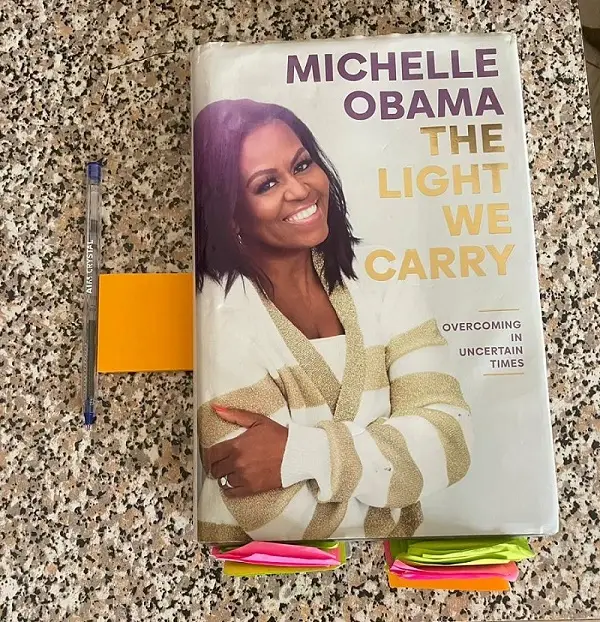
I marked so many pages my highlighter nearly ran dry. Some books give you advice; this one kept giving me sentences I wanted to keep close.
Lately, my energy has been low. Simple things feel heavy. Something sits on my chest. This book found me right then. It didn’t rush to cheer me up or promise everything would be fine. It just sat beside me like a warm, wise friend who leaned over and said, “Yeah, I’ve been there too. Let’s stop pretending.”
Becoming was Michelle Obama’s story of climbing. This one is her philosophy of staying upright. She shows you how to stand steady in an uncertain world, how not to fall apart, how to stay soft when everything hardens around you. No First Lady polish. She lays out her fragile moments, her tangled feelings, her fumbling attempts to figure things out. You read and think: she struggles like that too. Maybe I’m not so alone.
Low-intervention parenting, high-concentration love
One of the most moving parts of the book is how she writes about her mother, Marian Robinson. Growing up, Michelle’s mom didn’t hover. She didn’t panic. She gave Michelle and her brother room to fight, to fail, to figure things out themselves. Her mother said something that stayed with me: “I’m not raising babies. I’m raising adults.” That sentence hit hard. It’s trust. Pure trust in a child as a whole person.
Michelle turns that same lens on herself as a mother. Her daughters leave for college, one after another. She doesn’t cling. She learns how to stay close without getting stuck. The warmest part is how she thinks about her daughters dating. She doesn’t look down from above. She asks a quiet question: “Does this person feel like home?”
I won’t spoil the small stories she tells. But that clarity and gentleness will stay with you. This is more than parenting advice. It’s about loving someone and still holding onto yourself.
When your energy runs low, go tiny
I didn’t expect this book to actually teach me how to loosen up. Michelle doesn’t lecture. She gives you the small things. She broke down in the White House. She felt anxious in her marriage. She fought battles inside her own head. Her way out surprised me. She knits. She does puzzles. She makes her bed. She calls it “going tiny.” When everything feels too big, too heavy, too out of control, she finds one small thing she can handle. One stitch. One puzzle piece. One pulled-up blanket.
Reading that, I exhaled. When your energy is low, you need a small handle to hold onto. She writes about fear with the same honesty. She doesn’t scold it. She doesn’t pretend it’s not there. She says, “Fear is a companion, not a commander.” Then she shows you, bit by bit, how to sit with fear until it shrinks. I started sleeping better after those chapters. The book has that kind of quiet power.
Like a hug, like a gentle tap on the shoulder
Here’s what I want you to know. You don’t have to be a parent. You don’t have to be a woman. You don’t even have to care about politics. You’ll still find yourself in these pages.
Michelle writes about her circle of friends. They call each other mid-breakdown and never pretend to be fine. She writes about Barack. During awful meetings, he would hold her hand under the table. A small gesture that said, “I see you.” She writes about loneliness, jealousy, imposter syndrome, the exhausting pressure to look like you have everything together. Every time, she lands on the same truth: the light we carry comes from being honest about the dark.
That’s why I kept marking pages. She didn’t give me answers. She gave me permission. Permission to stop pretending. Permission to slow down. Permission to still be on my way. If you’ve been feeling tired, unsteady, worn out from performing strength, pick up this book. It won’t fix everything. But it will remind you that you don’t have to shine all the time. It’s okay to be a little dim. Really.