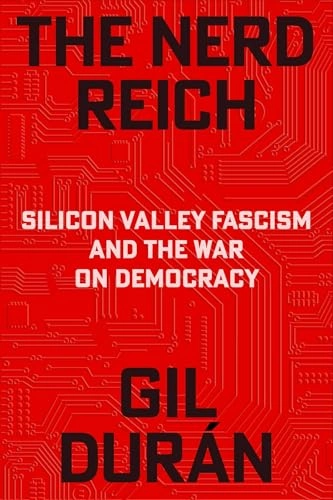
I finished The Nerd Reich on a Tuesday night, alone in my kitchen, the kettle long gone cold. I had picked it up skeptically. Another tech exposé, I figured. Another round of “billionaires are bad” that would make me nod and forget by Wednesday. Then I hit the chapter on The Sovereign Individual, and I realized I had been reading the wrong books all along.
Gil Duran’s central argument is simple and devastating: Silicon Valley was never libertarian. It was always proto-fascist. The book traces a straight line from a 1997 investment newsletter to the White House, and the line passes through Peter Thiel, Curtis Yarvin, Balaji Srinivasan, and Elon Musk. Duran, a veteran California political journalist, has the receipts. He has the podcasts, the essays, the conference speeches where these men said exactly what they planned to do. The problem was never that they hid their intentions. The problem was that nobody took them seriously.
The Men Who Said Exactly What They Meant
The book opens with the biographies of these men, and Duran treats them with the gravity they deserve, which is to say, he treats them as what they are: ideologues with unlimited funding and a plan to end the nation-state. Thiel emerges as the central figure, the connective tissue between venture capital and political power. Duran shows how Thiel bankrolled JD Vance’s transformation from Trump critic to Trump loyalist, how he funded the think tanks, the PACs, the whole apparatus. The chapter on the Antichrist is worth the price alone, where Duran demonstrates that by Thiel’s own logic, Thiel himself fits the description better than any of the women he accuses.
What struck me most was the chapter on Próspera, the experimental city in Honduras. I had visited Roatán years ago, snorkeling in waters I thought were simply beautiful. I did not know that a convicted drug trafficker had championed a tech-funded seasteading project on that same island. Duran connects these dots with the patience of someone who has spent decades watching these men operate. He knows their playbook because he covered San Francisco politics while they were weaponizing it.
The Frame That Changes Everything
The book’s great strength is its frame. Duran names the movement accurately: fascism. Not “techno-feudalism,” not “digital disruption,” not “innovation.” Fascism. And once you accept that frame, everything else clicks into place. The crypto obsession, the AI worship, the “Freedom Cities” proposal—it all reads as what it is: a coordinated effort to replace democratic governance with corporate rule.
It isn’t a perfect book, exactly. More like a necessary one. Duran’s resistance section is thinner than the diagnosis, and he does not fully theorize why these institutions were so easy to capture in the first place. The book also skews heavily toward Thiel, which makes sense given his influence, but leaves some of the other figures less developed. And the religious turn in Silicon Valley, which Duran treats partly as performance, may be more sincere than he credits.
Still, I could not put it down. Duran writes with a reporter’s clarity and an insider’s understanding. He knows these men are not geniuses. He knows they are, as one reviewer put it, adult versions of sci-fi nerds with too much money. But that does not make them less dangerous. It makes them more dangerous, because they are unencumbered by the self-doubt that might slow down a more reflective person.
What We’re Up Against
The book ends with a reminder that resistance is possible. Communities have rejected these projects. The tech right has failed before. But the window is closing, and Duran does not pretend otherwise. He does not offer easy answers. He offers something better: a clear-eyed account of what we are up against.
This book is for anyone who has wondered how the richest men in the world ended up running the government. It is not for anyone who wants to believe that Musk is just a quirky genius or that Thiel is just a contrarian thinker. If you are looking for comfort, look elsewhere.
I finished this book feeling less safe than when I started. But I also finished it feeling more informed, more alert, more ready to pay attention. That is the gift of good journalism. It does not make you feel good. It makes you see.
“Read it for the record. Then treat the record as a site survey, because it describes a demolition in exhaustive detail, and the question of what gets built on the cleared ground, theirs or ours, is still open.”
