Why Do Some Children React More Strongly Than Others?
One child can brush off a disappointing grade and get on with the afternoon, while another keeps thinking about it long after school ends. Some children adapt quickly to new routines, but others become upset when plans change or react strongly to criticism. Parents may wonder whether they are being too protective, expecting too much, or simply getting their child’s personality wrong.
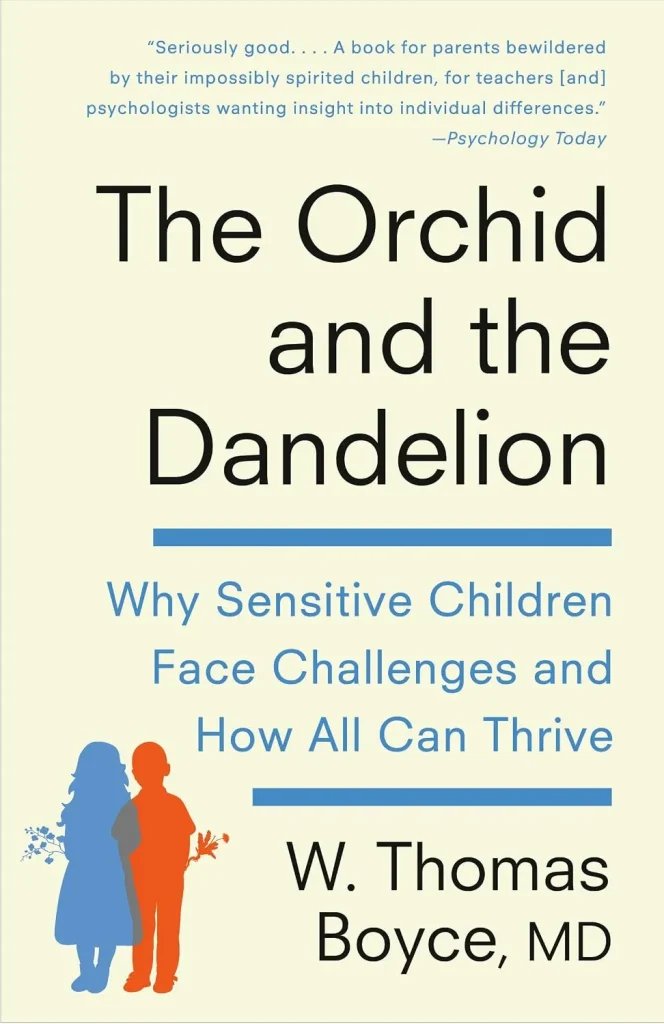
In The Orchid and the Dandelion, pediatrician and researcher W. Thomas Boyce explores why children respond differently to stress and their surroundings. His central idea is that some children are more sensitive to their environments than others, which can make them more vulnerable to difficult experiences but also particularly responsive to supportive ones.
Orchid Children and Dandelion Children
Boyce uses two flowers to explain these differences. Dandelion children tend to be more resilient across a range of environments, while orchid children are more sensitive to the conditions around them. When those conditions are difficult, sensitive children may struggle more; when they receive suitable support, they may have an especially strong opportunity to thrive.
The comparison is not meant to divide children into two permanent categories or suggest that one type is better. A child can be confident in one situation and sensitive in another, and temperament can interact with age, relationships, and life experiences. The metaphor is most useful as a reminder that children do not all respond to the same environment in the same way.
When a Child’s Reactions Seem Bigger Than the Situation
Parents sometimes struggle to understand why a seemingly small event leads to a major emotional reaction. A change in plans, a correction from a teacher, or a disagreement with a friend may leave a child upset long after an adult expects them to have moved on.
It is tempting to tell the child not to overreact or to insist that the situation is not a big deal. But what seems minor to an adult may feel genuinely overwhelming to a child who is more sensitive to stress. Taking time to understand the trigger can help parents respond more effectively than immediately criticizing the reaction.
That does not mean accepting every behavior. Parents can acknowledge a child’s feelings while still making it clear that shouting, hitting, or hurting others is not acceptable.
The Environment Matters More Than We Think
One of the book’s most interesting ideas is that children’s development cannot be understood through temperament alone. The atmosphere at home, relationships with adults, school experiences, and the way children are treated during difficult moments can all influence how they respond to the world.
Consider a child who becomes nervous whenever they make a mistake. Constant criticism may increase that anxiety, while patient guidance and room to try again may help the child become more confident. The child’s sensitivity has not necessarily disappeared, but the environment can influence how that sensitivity affects everyday life.
For parents, this offers a more useful question than simply asking how to make a child less sensitive: what changes would help this child handle challenges more successfully?
Supporting Sensitive Children Without Overprotecting Them
Understanding a child’s temperament does not mean removing every source of frustration. Children still need opportunities to solve problems, cope with disappointment, and learn to manage strong emotions. The challenge is to provide support without taking over every difficult situation.
Parents can start with a few practical habits:
- Give children advance notice when routines or plans are about to change.
- Help them put difficult feelings into words rather than dismissing those feelings.
- Break overwhelming tasks into manageable steps when appropriate.
- Set clear limits while remaining calm and respectful.
- Let children work through age-appropriate challenges instead of immediately solving every problem for them.
These approaches are not guaranteed to prevent emotional outbursts, but they can help parents respond more thoughtfully and learn which kinds of support work best for their child.
What Makes The Orchid and the Dandelion Worth Reading?
The book is particularly valuable for parents who feel that standard parenting advice does not always fit their child. A strategy that works well for one sibling may be ineffective for another, even when both children live in the same household and follow the same rules.
Boyce encourages readers to consider individual differences instead of treating every difficult reaction as a discipline problem. The book focuses more on understanding temperament, stress, and environmental influences than on providing a step-by-step behavior-management program. Readers looking for specific scripts for tantrums or defiance may need more hands-on guidance, but those who want to understand why children respond differently may find its perspective helpful.
Who Should Read It?
The Orchid and the Dandelion may be a good fit for parents and educators who want to understand sensitive children and their emotional needs. It is especially relevant for families dealing with strong reactions to criticism, difficulty adjusting to change, school-related stress, or children who seem easily overwhelmed by everyday experiences.
It can also help parents reconsider the way they interpret their children’s behavior. Instead of assuming that a child is being difficult on purpose, they may begin to notice how temperament and circumstances work together.
Final Thoughts
The Orchid and the Dandelion encourages parents to look beyond the behavior they see in front of them. A child who reacts strongly to stress may not need harsher correction or constant protection; they may need adults who understand their temperament and help them develop the skills to handle difficult situations.
The book’s most useful lesson is that good parenting is not about making every child respond in the same way. It is about understanding the child you have, providing appropriate support, and helping them gradually become more capable of managing the world around them.

